Rob, hero developer at Three Crown Interactive · 31 October 2026
For the past week I've been thoroughly reworking one hero: the Elementalist who chooses Fire. Not from the ground up, but a lot of him is new, and a lot is really polished to a higher standard: new mechanics, new abilities, a new talent tree and a new look for the fire itself. It isn't finished. The values are trial values, and the balance needs more work. But it already feels like a step in the right direction, and that matters more than this one hero. The Fire mage is the first hero I've reworked under my new rules, so he's becoming the yardstick I'll measure the other elements, and later the Soldier, against.
In short
- Heat: every Fire spell heats you up. The hotter you are, the harder you hit, until you overheat: bigger spells, more damage, and you start burning yourself.
- The vent: one key lets all that Heat out as a ring of fire round you. It's an attack; then you cool down over two seconds and win back part of the health you burned. In co-op, a healer makes the difference.
- Aim pays: a Fireball on an enemy's head is a critical hit.
- Variants: every Fire spell has two alternatives you choose in the talent tree, so two Fire mages can play very differently.
- A new ultimate: the Pyroclasm, a giant bomb of fire that drinks your Heat.
- The staff: its basic attack now has three forms to choose from.
- The talent tree: a web of five roads. Every point you spend makes the spell on that road stronger. The second element sits behind a lock in the same web, and you discover the web as you go.
- The fire's look: the Flame Wall now stands on the ground as real 3D fire, and the mage's aura is now a burning outline, like the Sword's red contour but in fire. Better than a week ago, and I'm still working on it.
Where Fire stood
Until a week ago, my Fire mage had four spells: Fireball, Flame Wall, Flame Burst and the Phoenix as his ultimate. You improved them with upgrade paths in a talent tree with tabs: one tab per element, and a "+" tab for your second element.
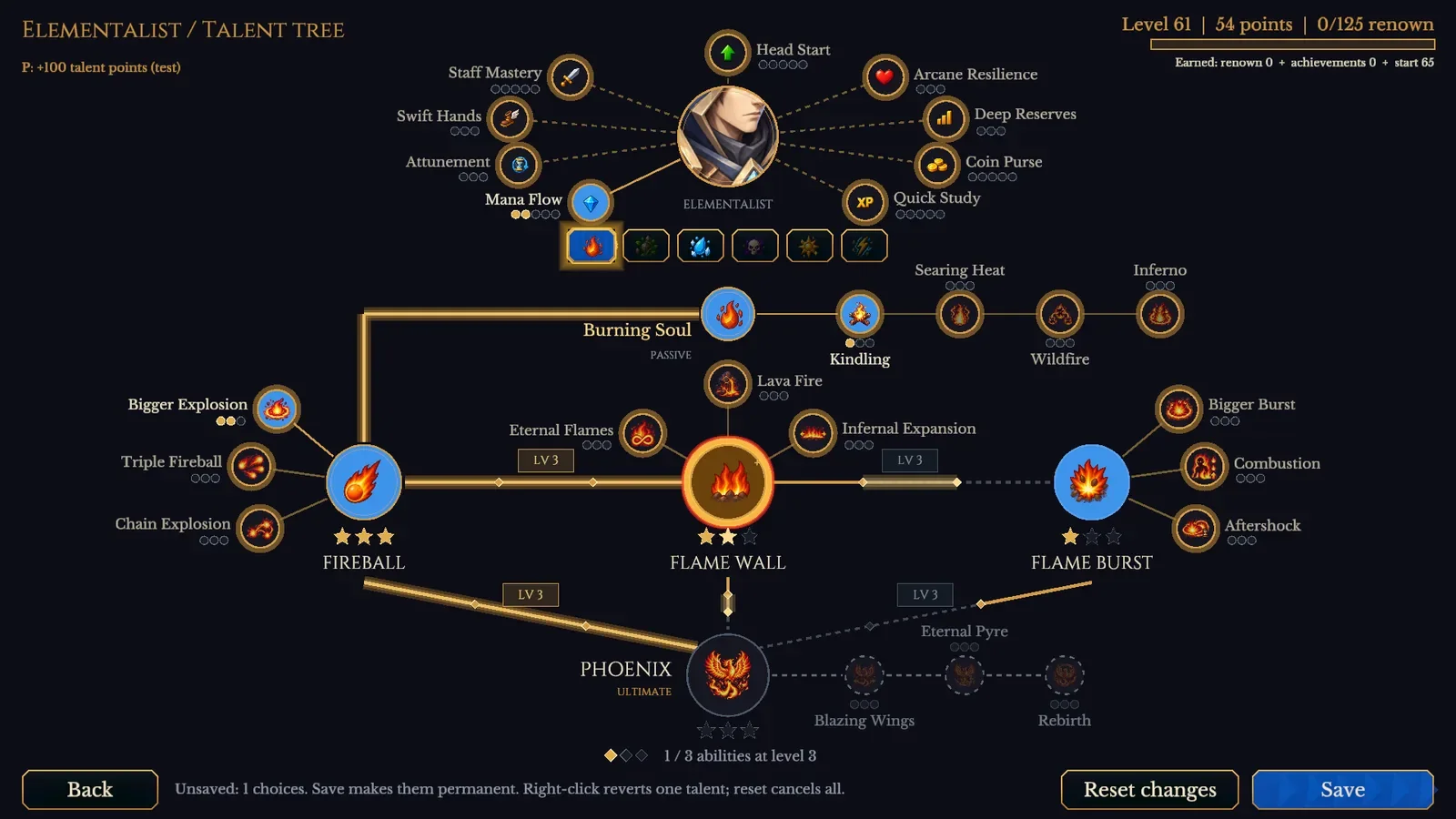
My old tree (21 October): it worked, but it had little structure.
It worked, but I wasn't happy with it. The second element felt unnatural, like something bolted on rather than something you wanted to discover. It didn't look tidy: little structure, no goal, no real choices.
Skills first
On 24 October I decided what the talent tree is for: choices and play style. Raw damage grows during a run, through the level-up cards you pick; the tree is where you decide what kind of hero you are. And I would start with one hero, the Fire mage, before touching the others.
Heat and variants
A day later I came up with the two ideas this rework is built on.
Heat. To me, the player was still too relaxed. And for fire I really see a mage who gives everything to the fire, but secretly gets consumed by it. Other games have mechanics like this; the warp in Warhammer 40,000: Darktide was a source of inspiration, although I wanted something different.
This is how I made it work. Every Fire spell adds Heat, half of its mana cost. Every point of Heat makes your Fire spells 0.5% stronger, so at 100 Heat they hit 50% harder. From 80 Heat you're overheated: your spells are 50% larger and hit another 25% harder, but you burn your own health every second. If you stop casting, the Heat cools down after 3 seconds.
Variants. I gave every Fire spell two variants that you choose in the talent tree and can swap between:
- Fireball: Pyroblast (hold it to charge a bigger, harder blast for more mana) or Living Bomb (the ball sticks to an enemy and bursts after 3 seconds).
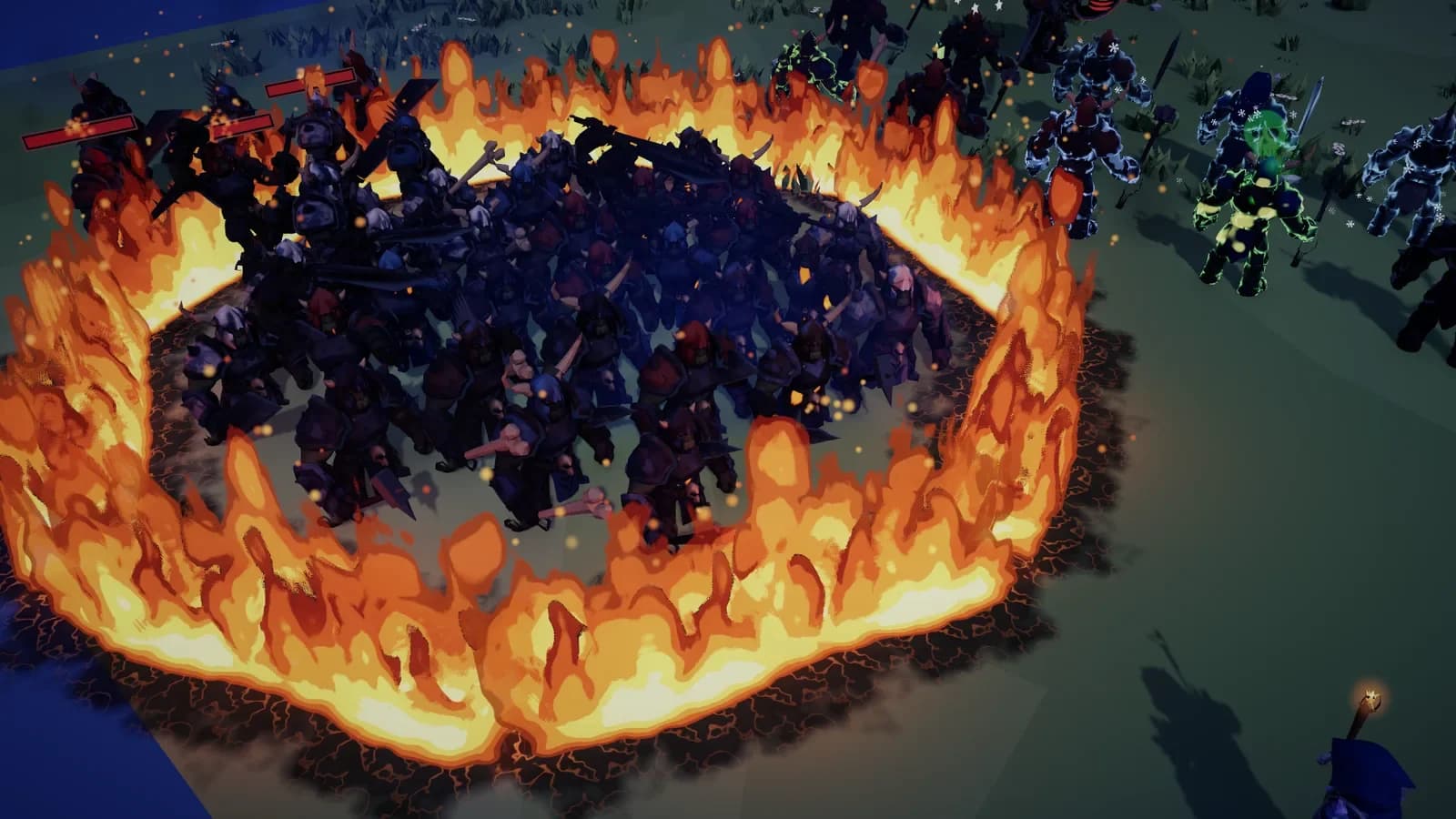
- Flame Wall: Ring of Fire (a closed ring round a point) or Advancing Flames (a wall that walks forward).
- Flame Burst: Flamethrower (hold it for a cone of fire in front of you) or Backdraft (it sets off every Burn stack you've put on the enemies in it at once).
- The ultimate: Phoenix Dive or Ash Guardian (more on that below).
The point isn't eight more buttons. Your build changes an ability away from its original form, and you can see in the game what you changed. That gives you room to experiment with different builds. Part of the idea came from the Phoenix: it never felt like a real Fire mage ultimate to me, but I thought some players might like it. So why not let you make an ability a bit different in your own tree?
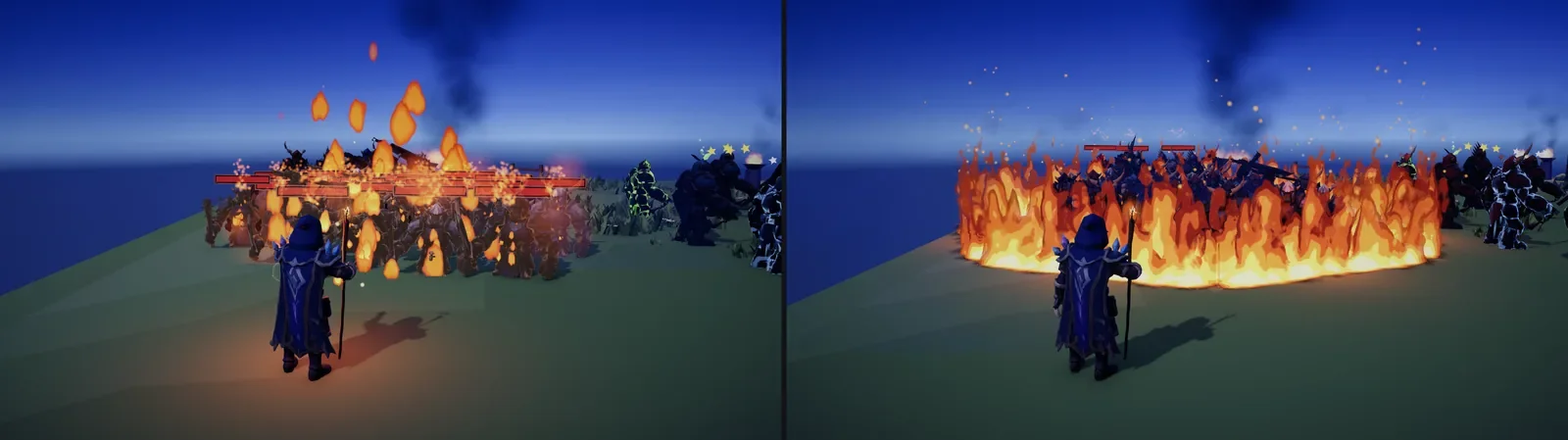
Two of the eight variants: the Flamethrower and Ring of Fire.
A new ultimate: the Pyroclasm
With a Fire mage I see gigantic explosions, like Roy Mustang in Fullmetal Alchemist, who snaps his fingers and sets everything ablaze, or Solo Leveling. I really had a picture like that in my head. So on 27 October I let the Phoenix go and came with a concept sheet in three steps: gather, descent, detonate.
I turned that into the Pyroclasm. You hold the cast, and a bomb of fire gathers 10 metres above the spot you aim at. Hold longer and it grows. While it gathers, it drinks your Heat, and every point of Heat it drinks makes the explosion bigger and harder. Let go, and the bomb falls onto the enemies and detonates. So the ultimate is also a way to cool down: you pour your Heat into one huge blow.
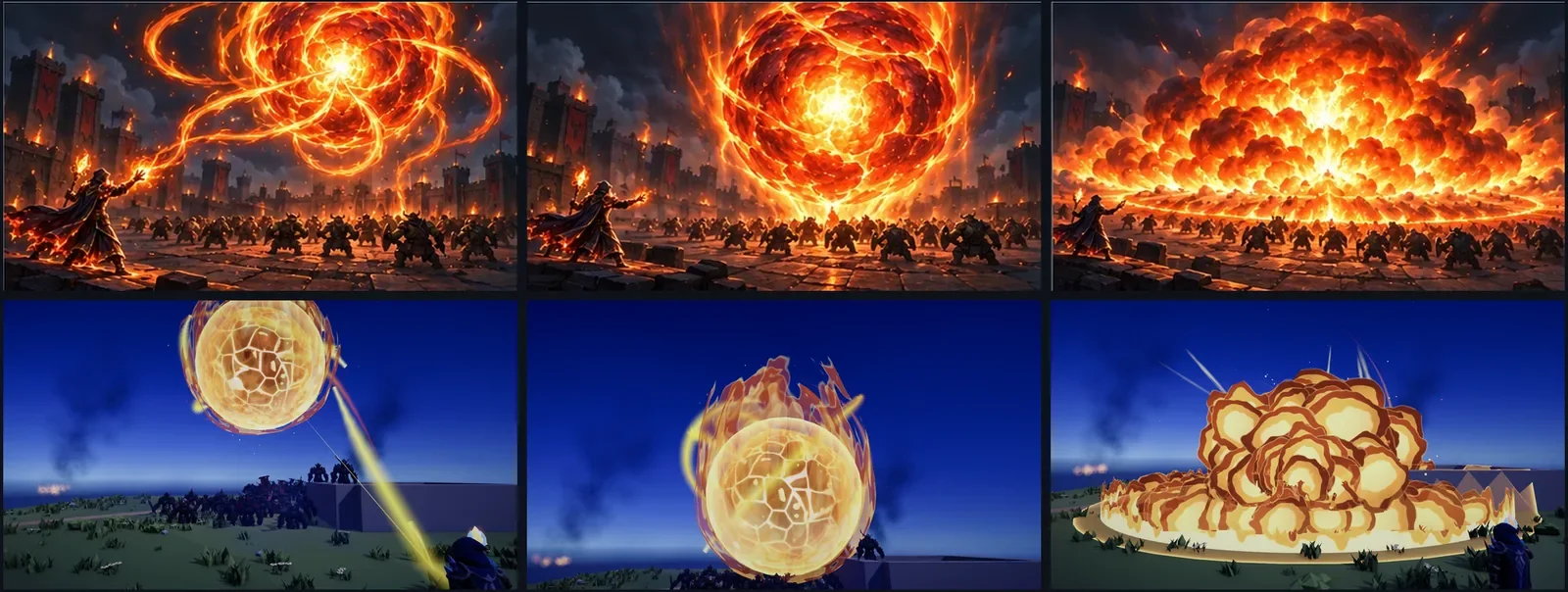
Above my concept sheet, below the Pyroclasm in the game (28 October).
I didn't throw the Phoenix away: it lives on as the two variants of the ultimate. Letting the player blow everything up without effort is fun for a while. But I want skill to be a real mechanic in this game. That's why the big damage costs health, why you run short of mana, and why you have to choose your moment.
Riding the peak
On 28 October I played the Fire mage myself on Nightmare. In one wave I was overheated for 90 of 122 seconds and burned 190% of my own health. And it felt good, actually. I saw myself dying, but I also saw my attacks grow. I saw huge areas and orcs dying by the bunch. I really got sucked in: yes, this is going great, I don't want to lose my Heat. It felt so good that at some point I simply had no health left and was suddenly dead.
For me, that was the moment I knew this is the right way. This is how a Fire mage should feel: massive area damage, but at a heavy price.
But I also didn't want you to keep dying out of nowhere when you play alone. So that same evening I added two things.
Fire on your screen. From 40 Heat, flames lick up the edges of your screen, taller as you heat up. Overheated, they burn along all four edges and flames rise from your hero's body. Other players see them on him too. I got lost in the fire rage without noticing; now you notice.
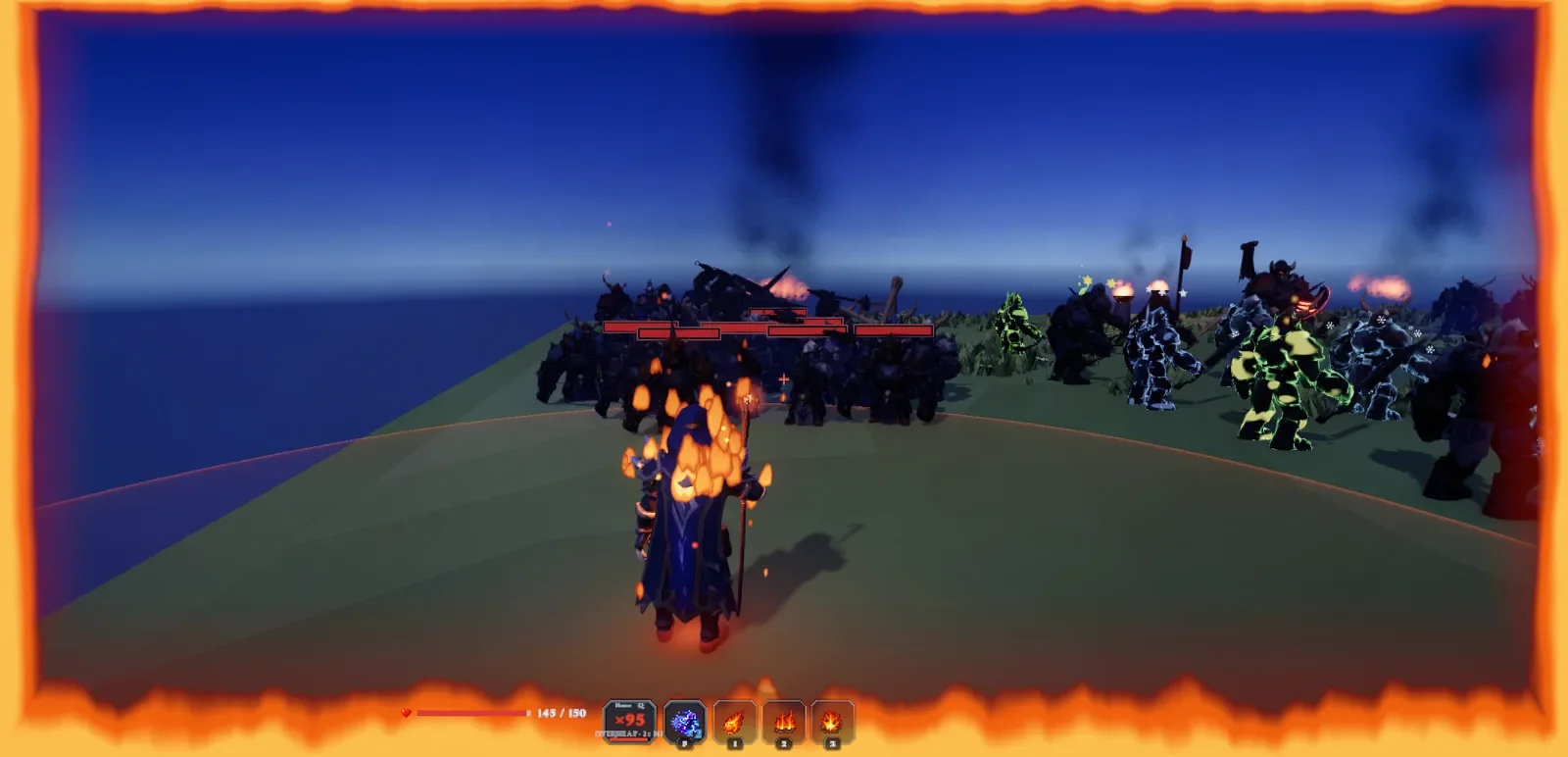
Overheated: the screen's edges and the mage himself are on fire.
The vent. Press Q and all your Heat leaves at once as a ring of fire round you. At 100 Heat the ring deals 150% of your spell damage and sets every enemy within 5 metres on fire. Your Heat drops to zero, the burning stops, and you get back half of the health the Heat burned since your last vent. So it's an attack and a choice: release it now as an explosion, or keep riding the peak a bit longer when you need the extra area and damage.
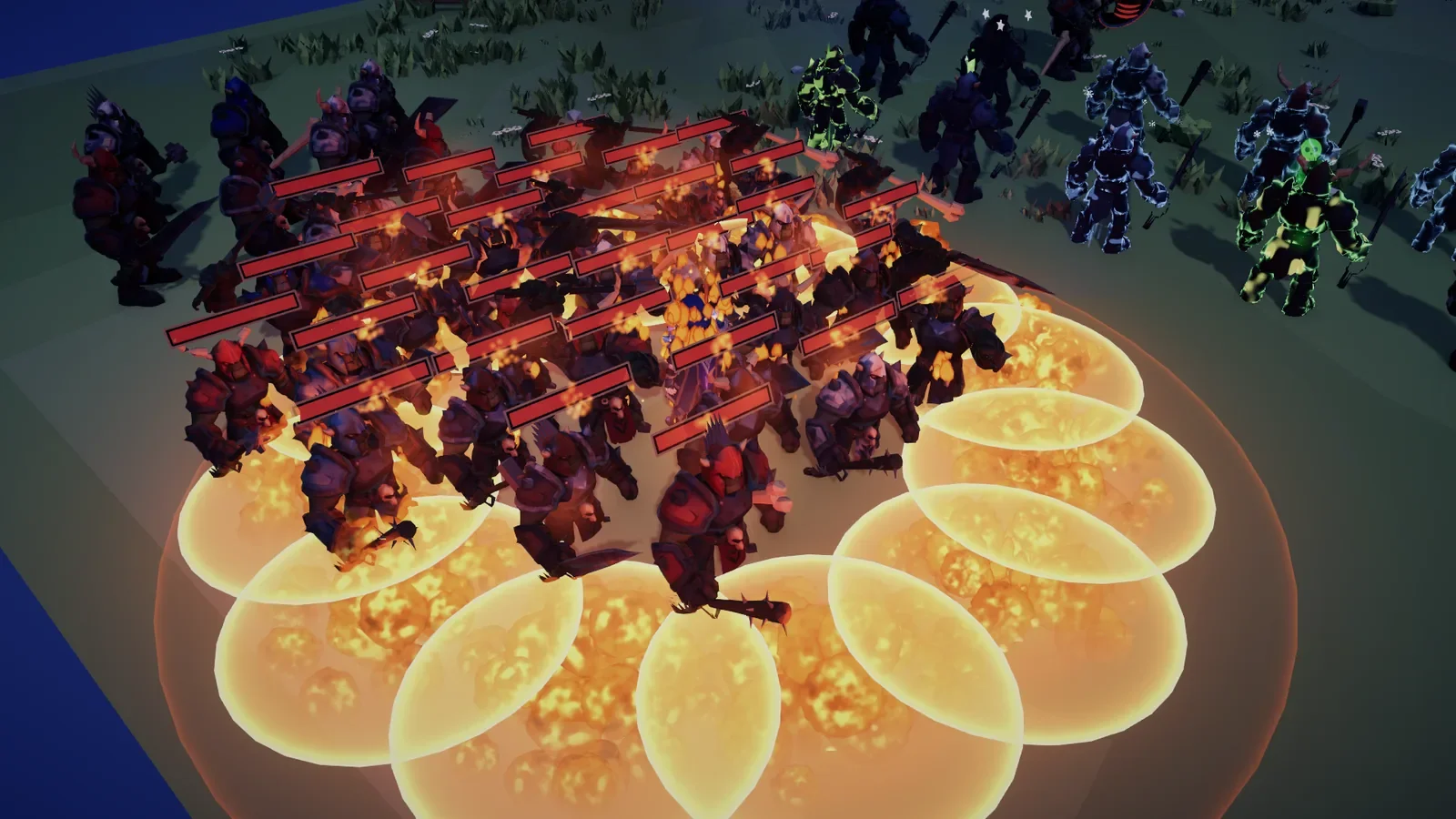
The vent: all your Heat at once, as a ring of fire.
I measured what the vent costs. In my test arena, with Fireball and Flame Wall against 15 enemies for 40 seconds, never venting gave 44.5 damage per second, but the mage burned 62% of his own health. Venting every time he reached 100 Heat gave 42.9 damage per second, about 4% less, and he burned only 24%. I measured that before the changes below, so the numbers will be different now.
Fire in line. The next day, my own play logs showed me the peak was too cheap. With a full tree I was overheated two thirds of the time, my mana never ran out, and I picked up less than 3% of the embers, the mana that burning enemies leave behind when they die. So since 29 October I make the peak cost mana and blood. Overheated, Fire spells cost twice the mana. The longer you stay overheated, the faster you burn: 2% of your health a second, 4% after 5 seconds, 6% after 10. Heat now only comes from your spells, not from kills. And the embers matter again, because they pay for the peak.
Burning, but not alone
Today I played the Fire mage again, in Act 0. Two things stood out.
In one game on Nightmare I died while I didn't have the feeling my Heat was that high. My log: in wave 4 I was overheated for 46.5 of 98 seconds and burned 145% of my own health, against 44 health lost to the enemies. And I never vented once. The burning screen edges weren't enough of a warning. So the staff plate now also says how fast you burn: OVERHEAT · 2× MP · -2%/s, then -4 and -6. From the second burn level, a line in fire colour under your ability bar says it plainly: You are burning: -4% health a second · Q vents your Heat.
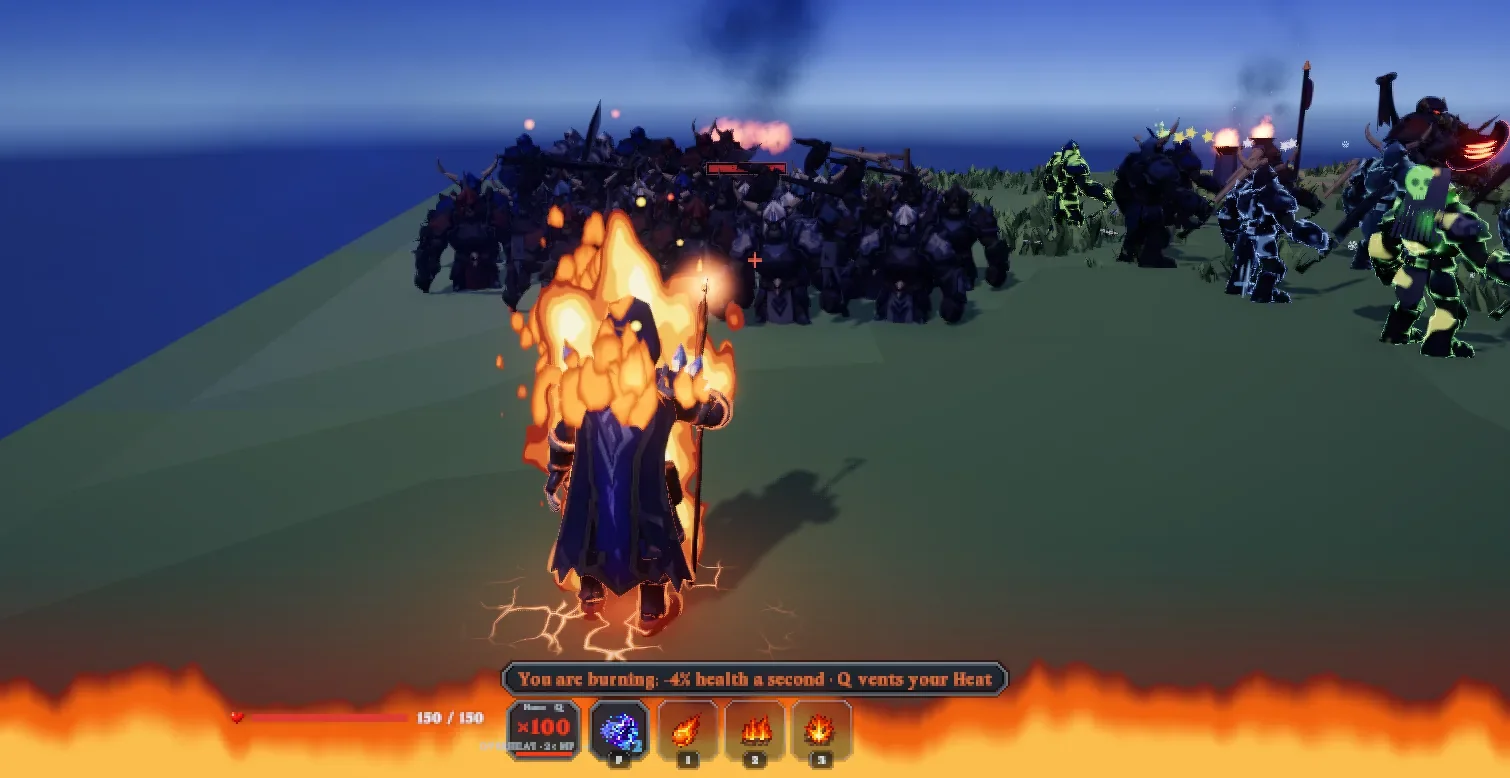
The Heat now says when it burns.
In other games the vent gave back too much: in one Nightmare mission it gave me 131 health back, 83% of my health. Staying in the fire too long shouldn't pay, but venting may give you a tactical advantage. And cooling down shouldn't be instant. So since today, the vent cools instead of resetting. The ring of fire still comes out at once, but your Heat runs out over 2 seconds. You win back half of what the Heat burned, but at most 20% of your health, and it comes back at 1% a second.
That leaves room for something I really want: in co-op, healing the Fire mage has to pay off. A healer should shine there. While you're overheated, venting or still winning back health, another hero's healing on you counts 1.5 times. So a good healer lets the Fire mage burn longer.
Aim pays. Also from my list today: if you hit an enemy's critical spot with an ability, that should be a critical hit too. A Fireball on an enemy's head now crits, just like the staff bolt. So do the Pyroblast, the Living Bomb's direct hit, Ice Shards and the Lightning Spear. The crit uses your own Critical Damage, +50% to start, so you can choose to make it grow.
The staff gets a choice
I found the staff's basic attack dull. So on 30 October I gave it three forms, chosen deep in the talent tree:
- Rapid Fire: twice as many bolts, each a bit over half as strong.
- Charged Bolt: hold it to charge for up to 2.2 times the damage. From half charge, it passes through an enemy.
- Split Bolt: it bursts where it hits, and every enemy within 2.5 metres takes part of it.
I also gave every element its own bolt: Fire shoots a dart of flame with a trail of sparks, Ice a spinning shard that shatters.
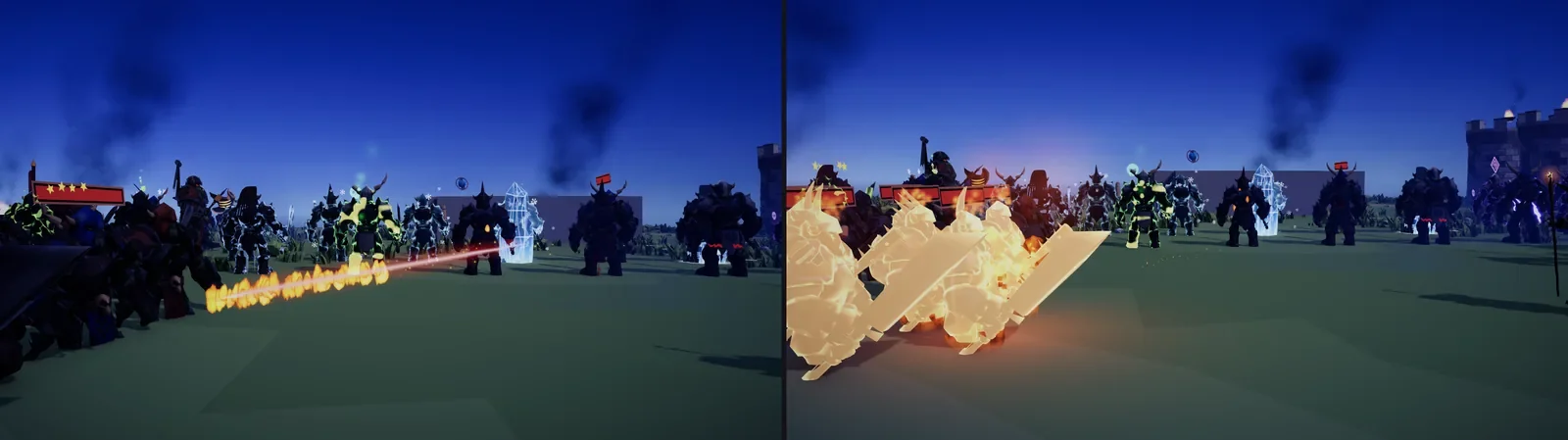
A Split Bolt on its way (left) and bursting in the crowd (right).
Which form I like best, I don't know yet. What I do know is what I want from it: a real feeling of progress. You already have renown and the gear that drops. But I also want other players to see how far someone is in the game, without it just saying "level 150". And I want you to feel: wow, I've grown. I keep coming back to my first experience in World of Warcraft, when I got my shoulders and my character suddenly felt super cool. I've tried to make the gear you wear visible in this game too, but I haven't managed it in a way I find good-looking enough. So for now, that growth shows in the staff: the staff in your hero's hand is the weapon you wear.
A tree you discover
Then the talent tree itself. On 30 October I reshaped it into a web of five roads leaving the mage, in the order of your ability bar: Fireball, Flame Wall, Flame Burst, the ultimate, and at the bottom a lock to your second element. Between the roads sit small webs for your staff, your body, your run and your play style.
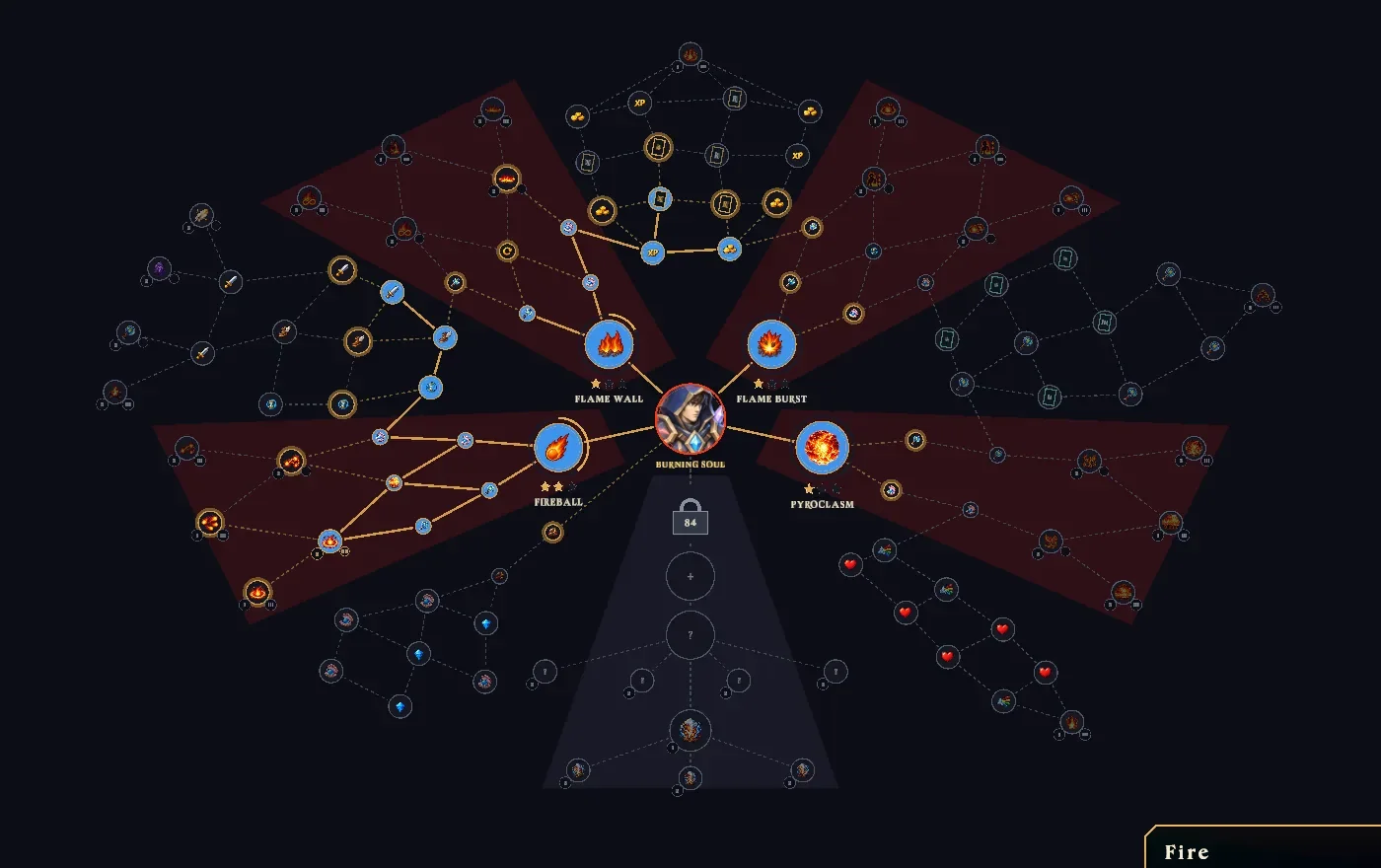
The five roads (31 October).
In the tree, all four spells are free from the start. I took out the separate level nodes: every point you put into a road makes that spell 2% stronger, and its level follows the road. Six points take it to level II, fourteen to level III, and each level makes the spell 10% larger. Close to the mage you find the small upgrades, like more area or less mana. Further out lie the variants, and at the end of each road its masteries. The web names only the spells; the rest is on hover. So every point you spend makes your abilities grow, and you get more of a feeling that you're choosing things.
The second element used to be a "+" tab. I moved it into the same web, behind a lock that hangs from the mage. The lock shows how many points you still need: 100 points in your tree. Every point you put in flies to it as a spark. At 75, 50 and 25 points left it cracks, and at zero it breaks open in gold. Behind it you choose your second element, then its first spell with its upgrades, and further on the elemental combo of your two elements.
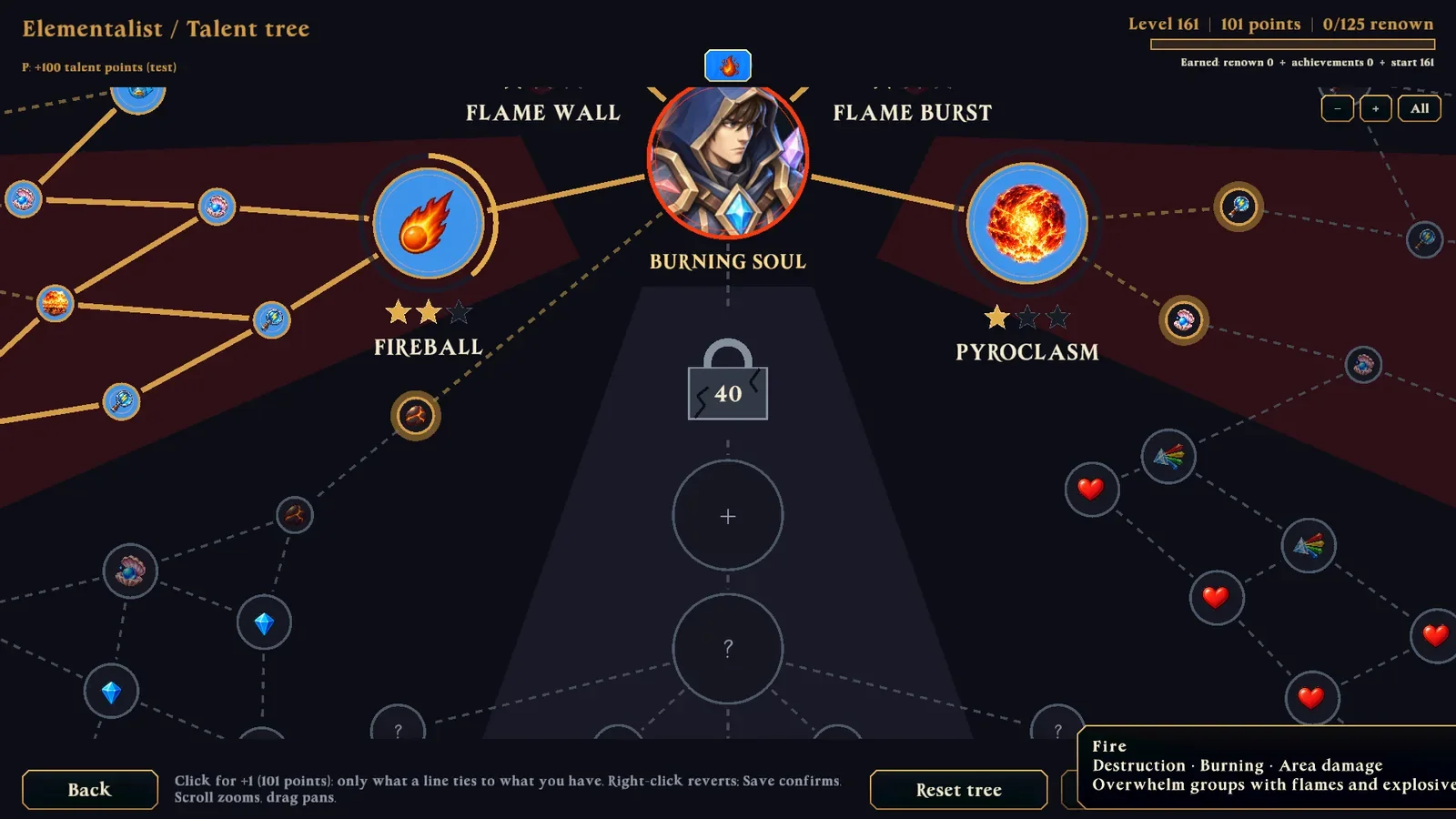
The lock to the second element counts down.
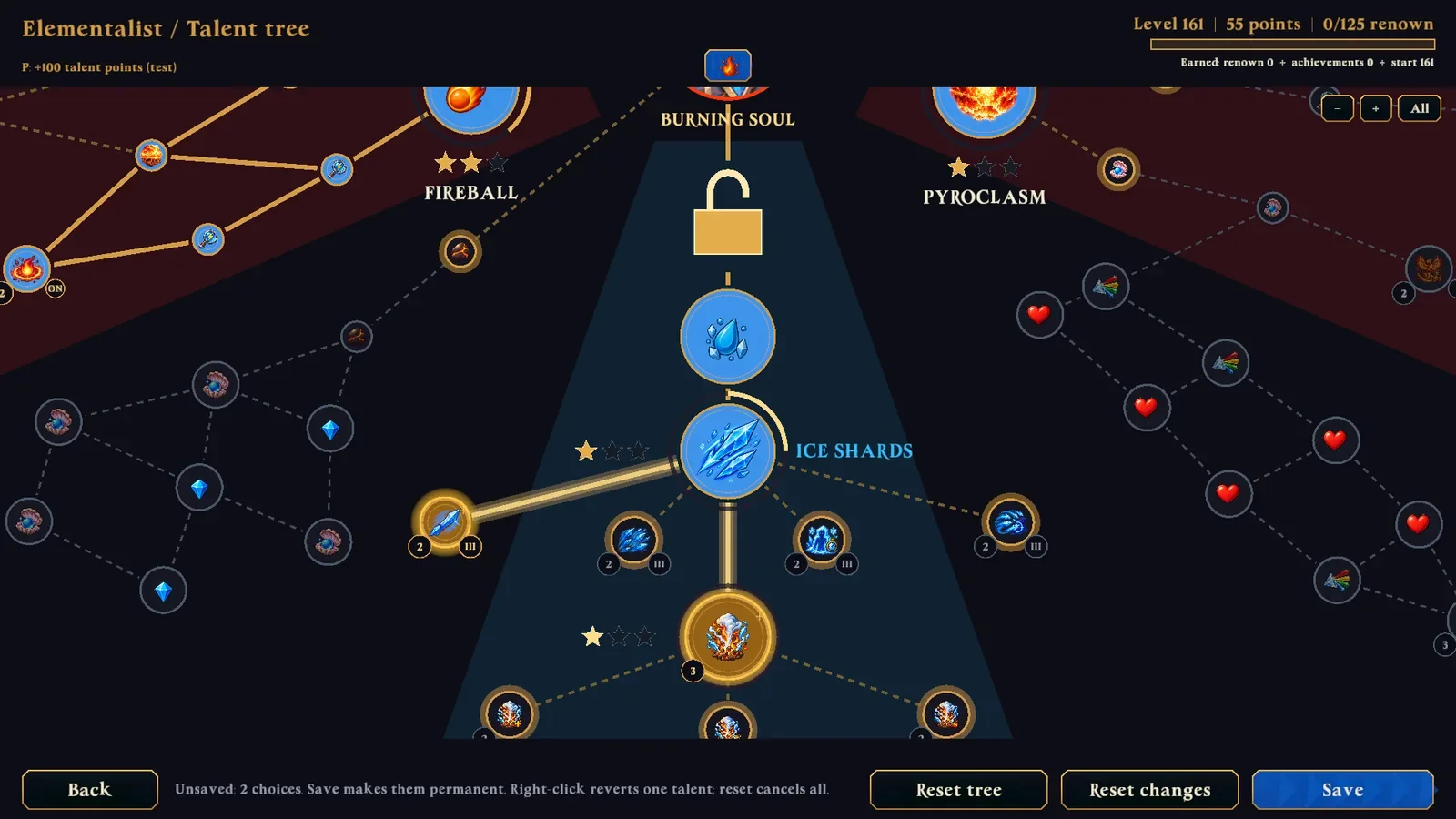
Opened: here the second element is Ice.
You don't see it all at once. The page shows what you have and what you can take now. The next ring shows as dark nodes with a question mark; I don't draw anything beyond that. A new Fire hero sees his four spells, their first upgrades and a ring of question marks, and a counter says how many are left to discover. He starts with a single talent point: his whole kit is already free, and that one point teaches him how the tree works.
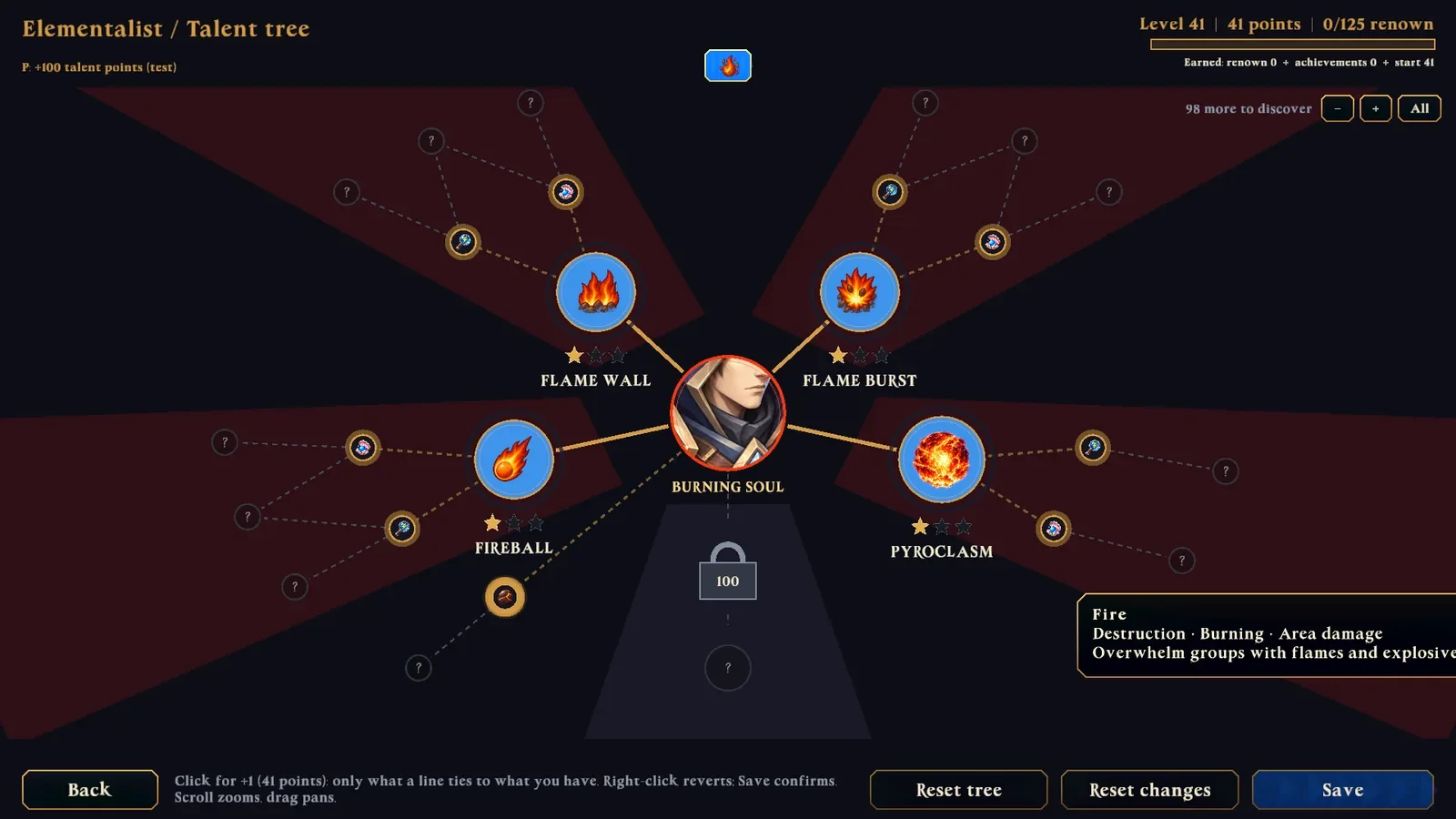
Discovering the web: you see only as far as you can take it. Here 98 nodes are still hidden.
Why hide it? To give a real feeling of discovery. Sure, later you can probably look it up on a website. But I hope most people are curious: what's behind this, what comes next? And that it makes them think: that's why I want to play this again. It's not about making you addicted; that's not my game model at all. It's about being pulled into the game: the roleplay, the mechanics, building and discovering. Lots of small things that together make a good game: how you level and grow, how loot drops, how you discover the tree, how you get your cards, how you do missions. And preferably with your friends, because for me that's always the most important thing.
Fire that looks like fire
This is the part that isn't finished. Fire is really hard to get beautiful in a way where I say: it fits the game, it moves the way I expect, with everything around it, scorched ground, embers rising, 3D effects, smoke.
It's going in the right direction, though. On 28 October I gave all Fire attacks the stylised look of the Pyroclasm, after Tim and Arjan preferred stylised over realistic. I had the Fireball redone as a painted ball of fire after a concept picture of mine. I turned the embers on the ground into small fires you can actually see from your hero's camera. And this morning I started the Flame Wall over completely: it had no base where the flames come out of. I began with a fire shader on a 3D shell, built on the approach of Febucci's fire shader tutorial.
From the front it started to look fun, but from the side it was clearly not 3D at all. And a wall cast on a hill should follow the ground up the hill, not cut through it or float above it. So during the day it became a real volume: the fire stands on the ground, on a slope and in a hollow, and it has depth from the side. At its base the ground scorches, with glowing cracks, as if the ground feeds the fire.
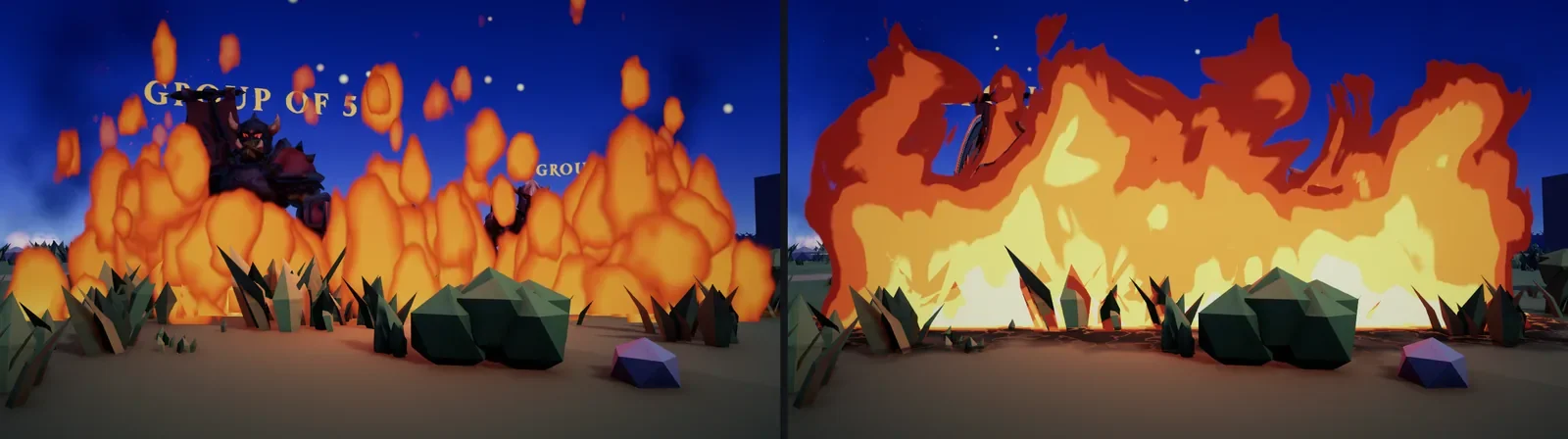
The Flame Wall before the restart (30 October) and as a volume (31 October).
Then something didn't add up in my head. The fire moved the way I expected, but it wasn't see-through. Fire is light, not paint. Now thin flames, the tips and a smouldering wall let what's behind them show through; only the hot middle and the bed nearly hide it. That helps the fight too: you can see the enemies behind your own wall. Seen from above, it still looked like one flat slab, so now it breaks up into separate tongues at different depths. And I wanted the small cinders that come loose from a fire, rise and die out, and a little smoke. They're in. So a good part of my list from the top of this chapter got done today: scorched ground, rising embers, 3D, smoke.
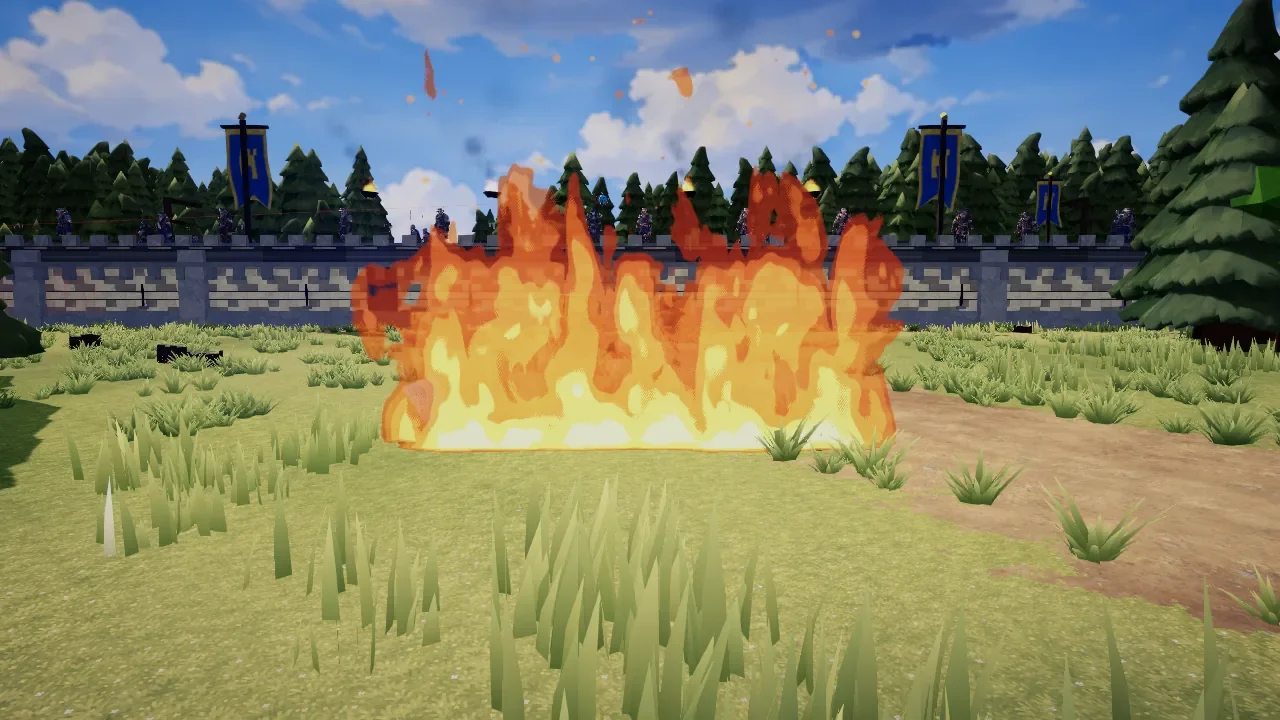
The Flame Wall now: on the ground, see-through, with cinders and smoke.
The mage's own aura changed with it. It used to be small fires dancing round the mage. I wanted the mage to be the fire, as it were: a glow with light flames round the body. First I tried the Flame Wall's fire on a sheet round the outline. Today it became what I really had in mind: like the red contour of the Soldier's Sword, but in fire. A burning outline on the body itself, with tongues of fire, and the Flame Wall's cinders rising off the shoulders, arms and robe. In a run it grows wave by wave, up to the step your gear has unlocked.
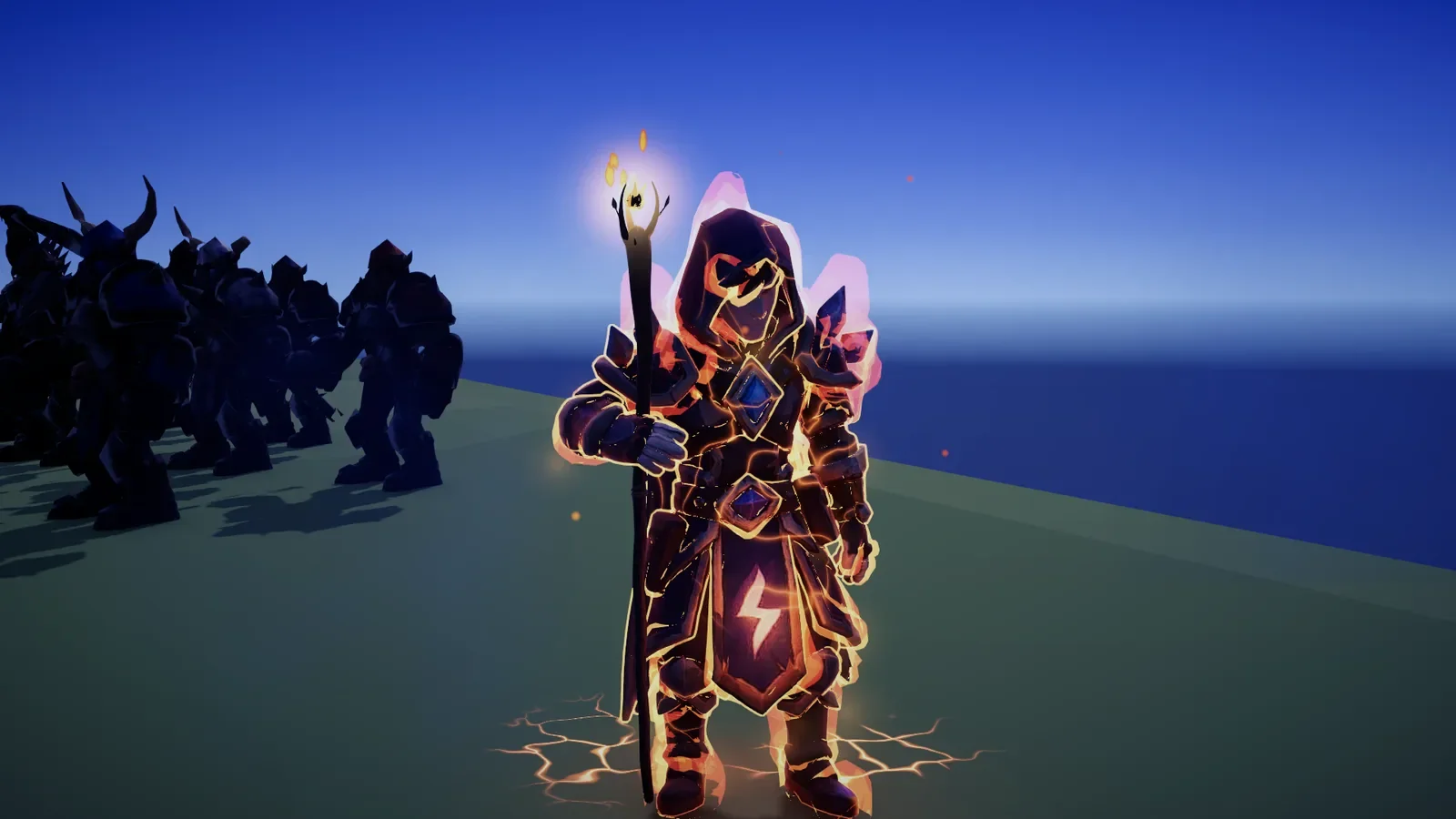
The new Fire aura, here at its highest step.
What I'm learning: iterate
At work, things are often very functional: this has to be automated, and so on. With game mechanics, where "fun" is much harder to pin down, it really is: make something, test it, write down your ideas, test it again. What annoys me? What do I feel? What am I missing? Change it, test again. I've been round that circle a hundred times. That's what got my heroes, and now especially the Elementalist, to the point where I think: people are going to have an enormous amount of fun with this.
Working with AI helps me a lot there. I work a mechanic out quite a bit first, and then it gets built in quickly. Sometimes the AI comes back with a question I hadn't asked myself. With the talent tree, I was making the ultimate different, and it asked: what about the normal abilities? Really good things come out of that. The fire, on the other hand, is the hard part. I'm still iterating on that.
The yardstick
How Fire feels now is what I want to give every hero: a mechanic of its own that he can exploit, and that lets him play his role, whether that's area damage, single target, slows, healing, summoning or setting up combos. Concretely, I'll give the other elements:
- the talent tree as it looks now, with the second element tied into it, and discovering it;
- a Heat of their own, carried over in a way that really fits that element;
- the staff's forms.
Later the Soldier too, and one day the Hunter, when I get to him. But first the Fire mage has to play well.
How I tested
- Every change has its own automated tests in Unity. The vent numbers come from a measurement in my test arena under the conditions above.
- I took the fight pictures today in the hero test arena, on the current build, with the game paused at each moment. The see-through Flame Wall I took in Act 0.
- I tested the overheated flames, the vent, and the cooling vent with a healer's bonus in co-op over LAN on one PC, with the hero on the host and on a client.
- I played the Fire mage on Nightmare before the vent and the "Fire in line" change, and again in Act 0 today; those games led to the warning and the cooling vent. Not played yet: the cooling vent itself, the head crits, the new Flame Wall and aura, the five roads, discovering the web and the staff's forms. Nobody has played this version with the whole team yet.
What's next
Playing this version myself and with the team, then tuning the balance. Whether the burn itself should change is still open: overheating only at a full bar, a burn that can't take your last 10% of health, or a slower rise. Maybe the warning is enough; playing will tell. More work on the fire's look, with the other Fire attacks next. And once Fire plays well, the same pattern for the other elements.
About me
I've been gaming for almost 35 years, and in daily life I work in coding and automation at enterprise level. Making a game with my friends is a dream I've had for a long time. I make it first of all to play it myself, alone and with my friends. I want all the creativity, time and effort I've put into it to leave me convinced that this is a good game. Not "wow, the graphics are amazing"; the style has to fit, but the game has to be finished and fun, without the feeling that I cut corners anywhere. Quality, not something made in a hurry.
With the help of AI, I can actually build my ideas. That leaves me more time for concepts, trying ideas, playtesting and tuning. The design choices are mine, and every number in this post comes from a test run or my own play logs.
Earlier: The heroes find their voice. On the Elementalist: Heroes, part 1: from capsule to Elementalist and Heroes, part 2: six elements, six ultimates
Made possible with AI. I wrote this post with the help of an AI assistant (Claude): it turned my notes and my answers to its questions into this text, and I read and approved every part of it. Claude also writes and tests a large part of the code for my heroes from my designs, and the concept art comes from an AI image generator in a style I choose. The pictures of the game come from the current build.