I'm Rob, and on The Last Bastion I'm the one building the heroes. While the builder raises walls and towers, the heroes are the players on the ground: they run, cast, cut and hold the line where the defence is about to crack. This is the first of four posts about how they came to be. We start at the very beginning, with a figure made of capsules and a man in a shirt.
Day one: capsules and a camera
The first hero was not a hero at all. On 12 September he was a blue figure made of capsules, with a camera behind his back, walking around a test floor next to a green box. That was enough to answer the first questions: how does the hero move, how high does he jump, where does the camera sit, and does he bump into walls the way you expect?
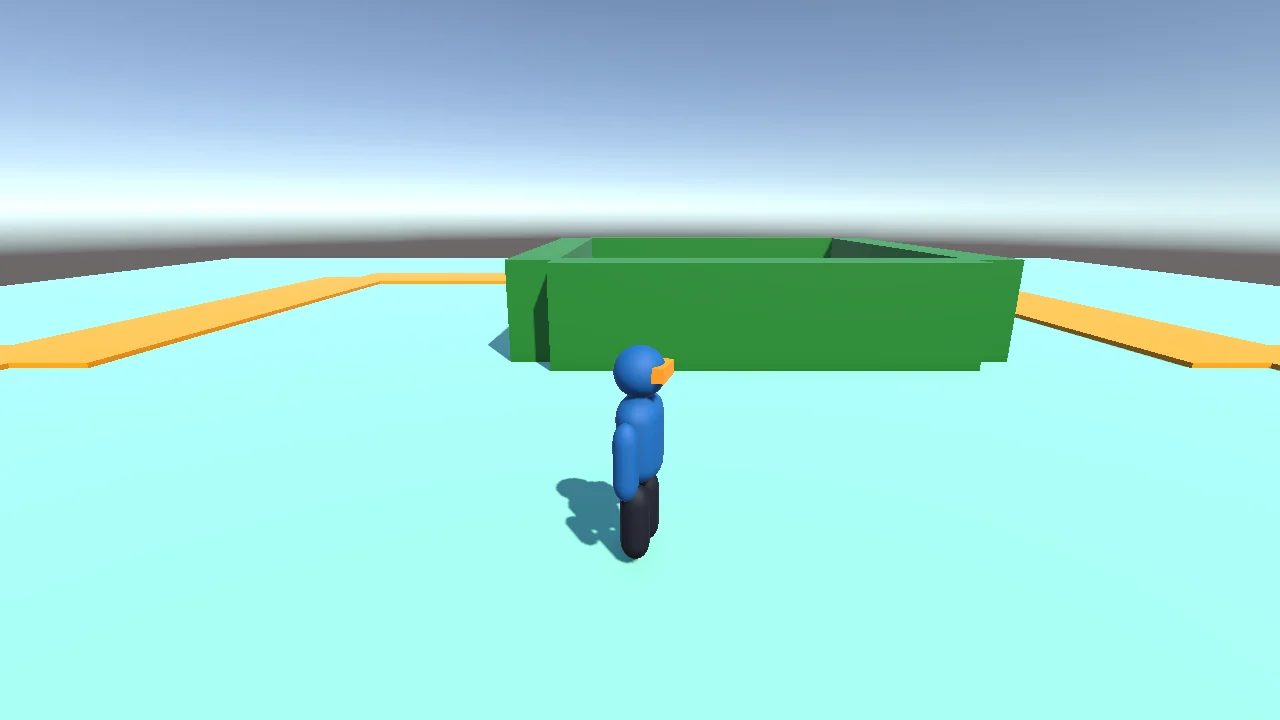
12 September: movement, jumping and the third-person camera, tested on a figure made of capsules.
A simple hero from Blender
The next day the hero got a real body. I built a simple, friendly hero in Blender: shirt, boots, a belt and an iron sword. Nothing fancy, but he was rigged and animated, so he could idle, walk, run and swing. In Unity he got blending between those animations based on how fast he actually moved, a golden slash arc when he attacked, blocking on the right mouse button and a small heal on Q.
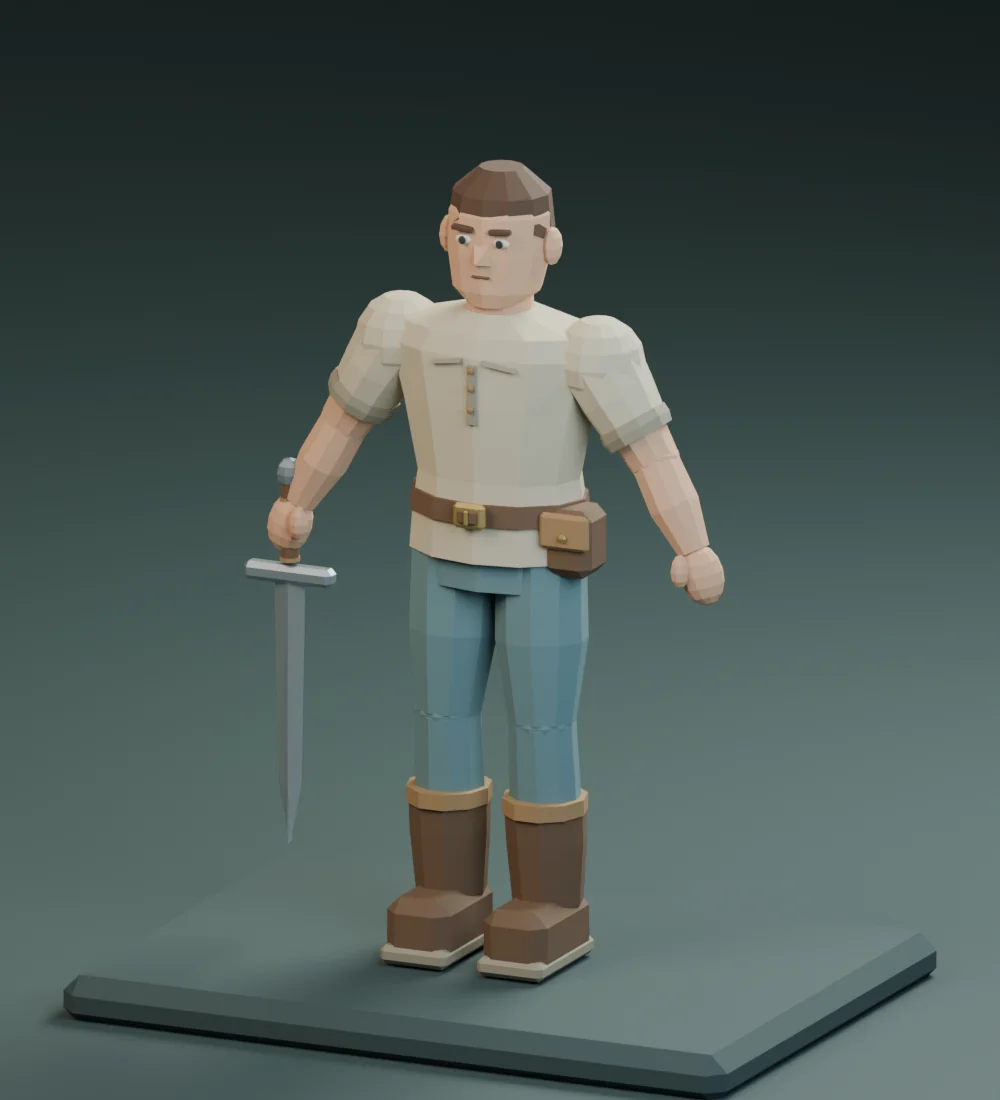
The early shared hero from Blender, the same body every class started with.
With a body came the first basic abilities. Equipment decided damage, range and attack speed: a sword cleaved through a few enemies, a maul hit one target hard, a bow fired a visible arrow. The staff threw a fireball and called down a meteor. On every level-up you picked one item, and the hero screen showed what it did to your stats. It was rough, but it was already a loop: fight, level, choose, fight again.
On 14 September that one hero split into three classes: Soldier, Hunter and Elementalist. They still shared the same body. The difference was in the weapon and the abilities.
The Elementalist on a borrowed body
The Elementalist started as that same shared hero holding a staff. The capture below is from that day. The spell bar already reads Fireball, Holy Beacon, Water Wave, Chain Lightning, Steam Eruption: the first, very early version of the element idea. Most of those spells have since been replaced, but the core idea stayed. You don't pick one mage, you build one out of elements.
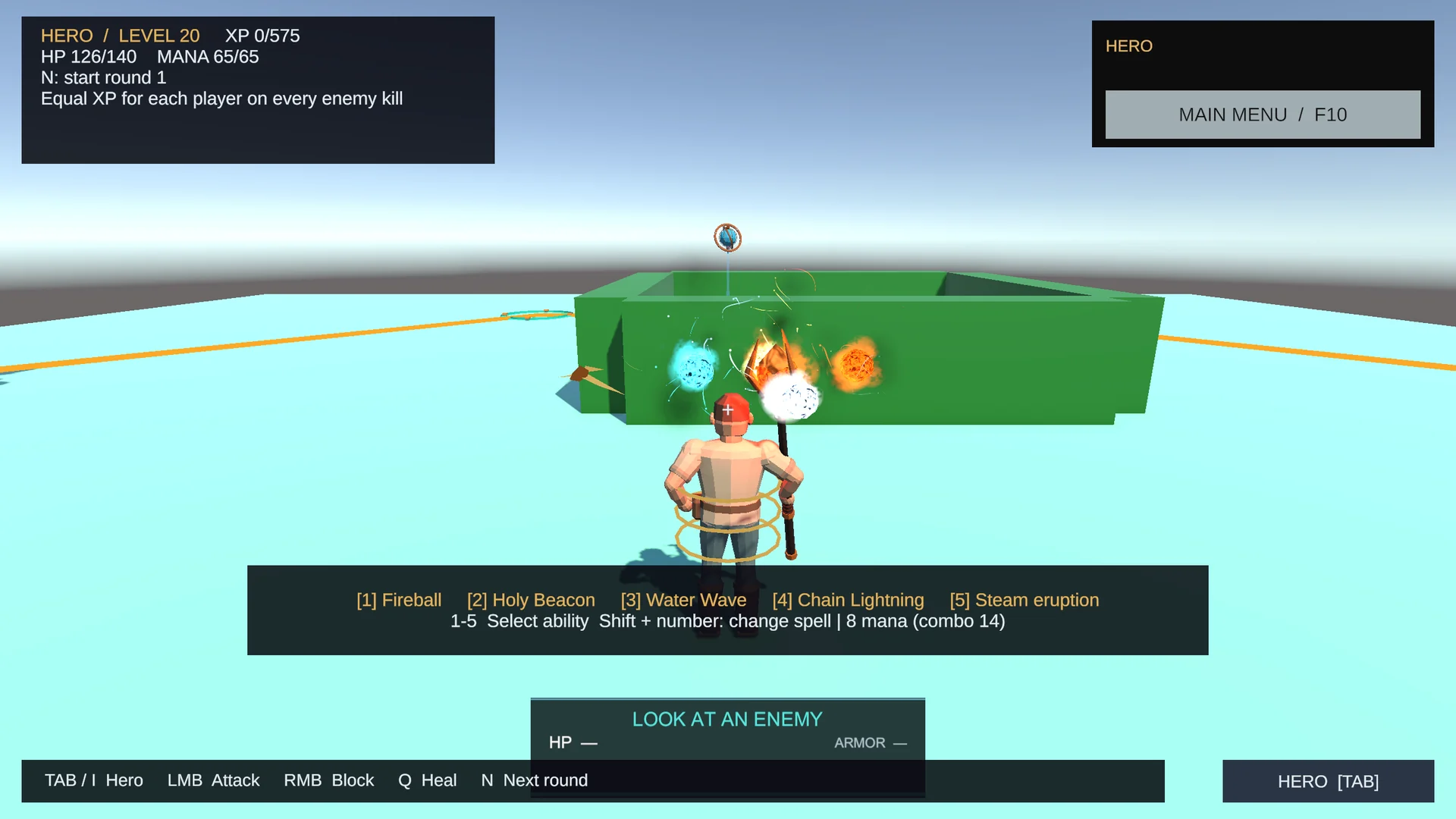
14 September: the shared body as a mage, with the first element spells on the bar.
Armour that grows with you
The moment the Elementalist existed, I wanted his progress to be visible. If you have been fighting for twenty waves, you should look like it. So on 15 September the mage got a simple modular armour set, Aetherweave: robe, chest piece, gloves, boots, a headpiece and shoulders, each one able to appear separately on the existing skeleton. Start in plain clothes, end in full armour.
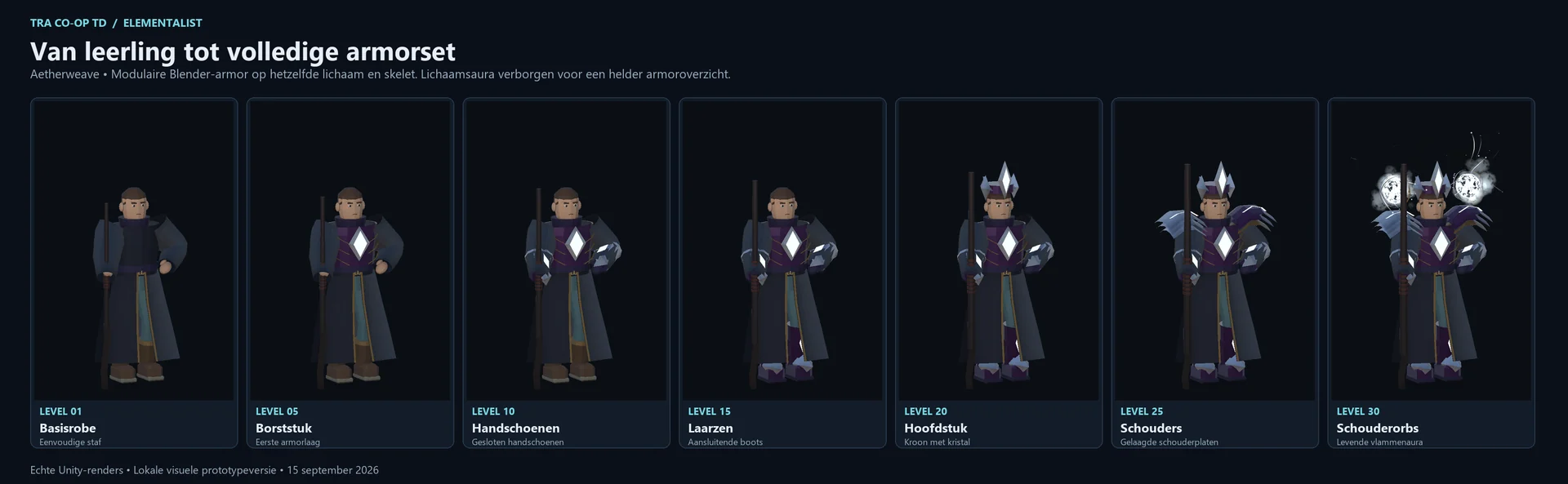
15 September: the armour pieces appear one by one as the hero grows.
The staff got the same treatment. It grew a crown and elemental orbs, one for each element you chose.
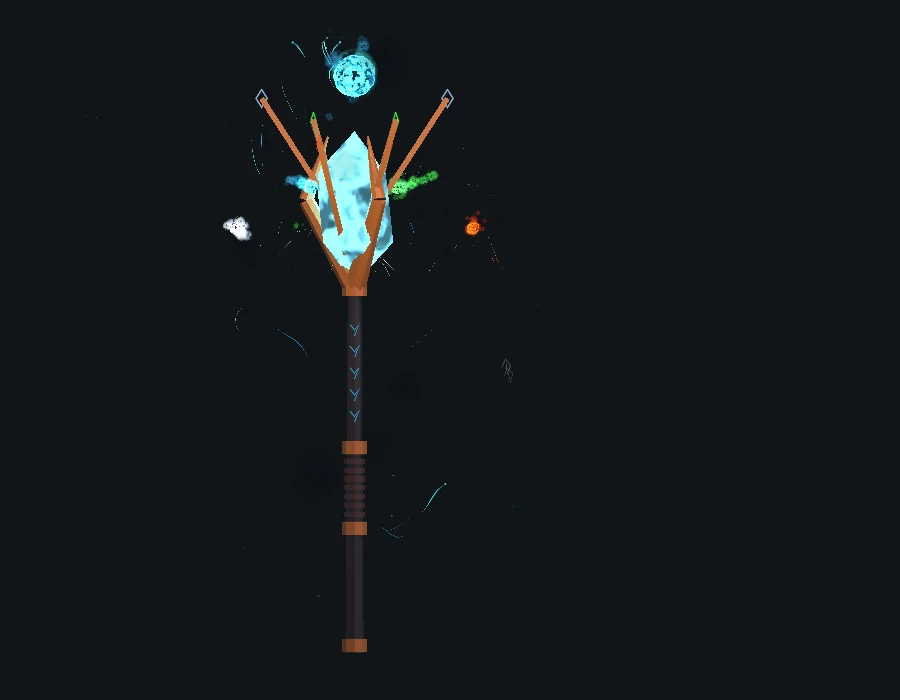
An early version of the growing staff.
On 18 September I pushed the idea further in a separate Blender study, from apprentice to ascendant, to see how far a full growth path could go. That study never went into the game, but it set the tone: progression should be something you can read from across the battlefield.
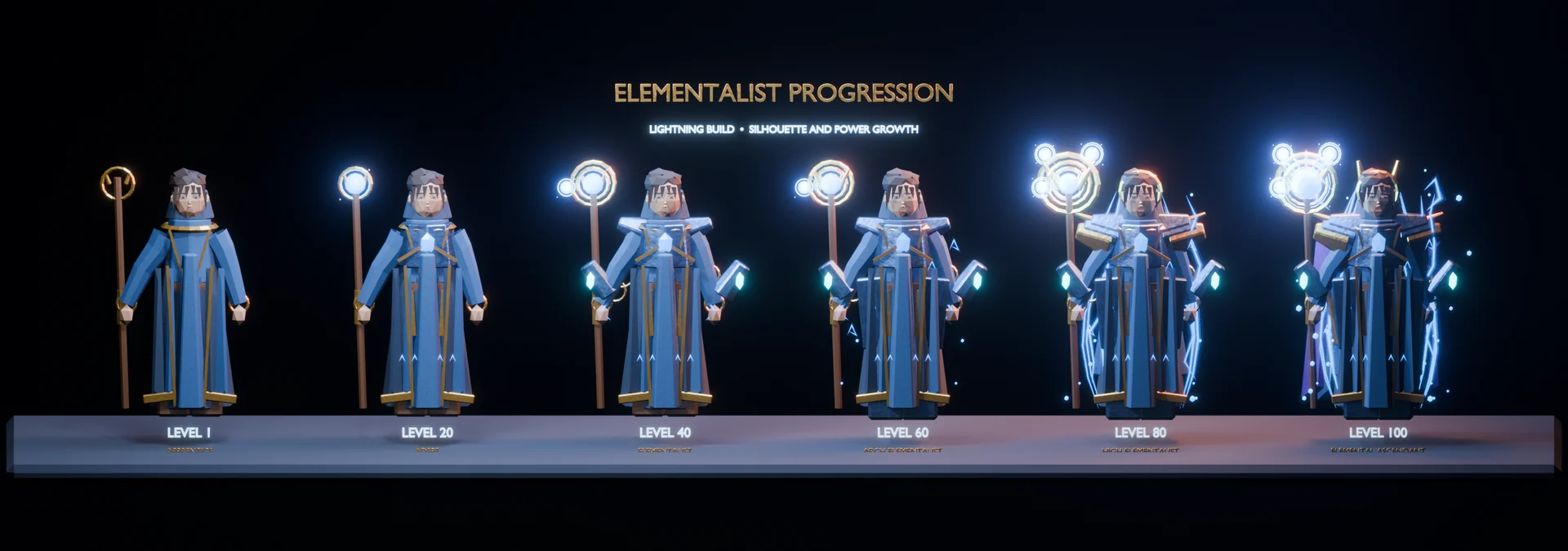
18 September: an art study of mage progression. Not in the game, but it set the direction.
A new mage, and a staff that tells your story
On 19 September the Elementalist got his own body: a proper mage model, made with Meshy and rigged for the game. Then came the work that nobody notices when it is right. I tuned his posture, his walk and his casting, and fixed the staff grip so it no longer slid through his fingers. At a walk he leans on the staff like a walking stick; when he sprints he carries it.
The staff became the place where your build shows. The source model had almost half a million triangles; I cut it down to around twelve thousand and split it into growth stages. Every element you choose adds a stage of carved wood, rings and crystals, and puts its own orb in the next free ring. The crystal takes the colour of your dominant element: orange for Fire, green for Nature, cyan for Ice, gold for Lightning, white for Holy, violet for Shadow.
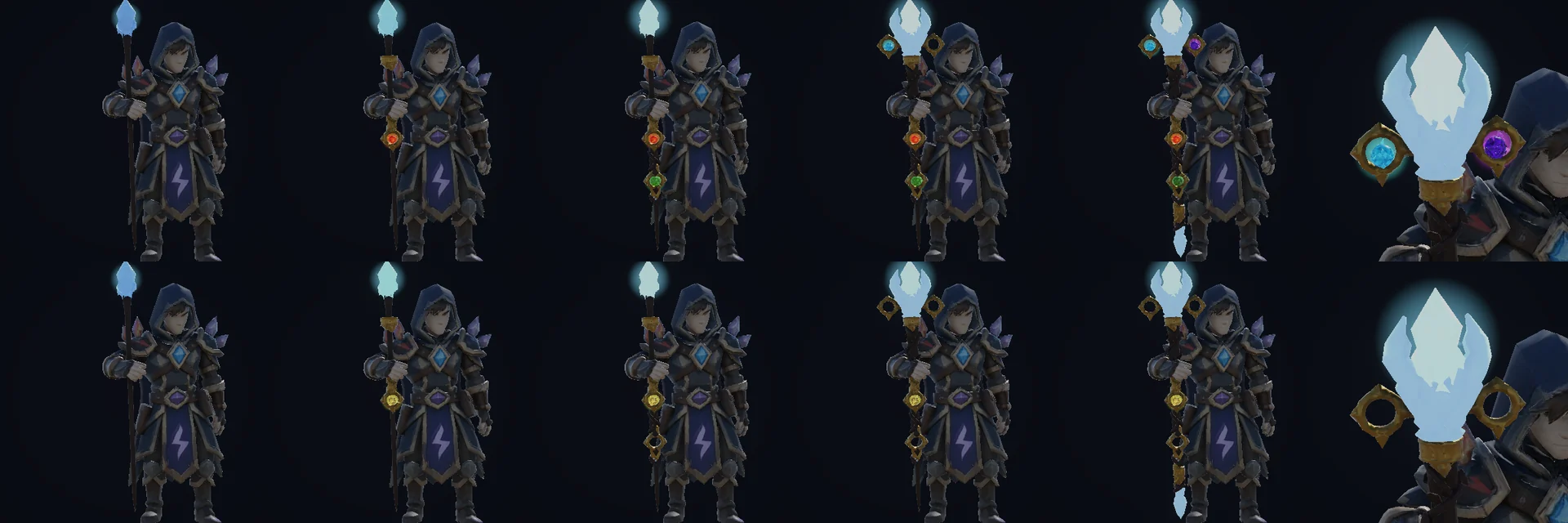
The current mage. The staff grows with every element you take.
One part of the plan is still open. The new mage is a single closed mesh, so the armour pieces can't yet appear one by one the way they did on the old body. I'm waiting for a version of the model with the parts separated, and then the body will grow along with the staff.
Then and now
Three weeks, from capsules to this:
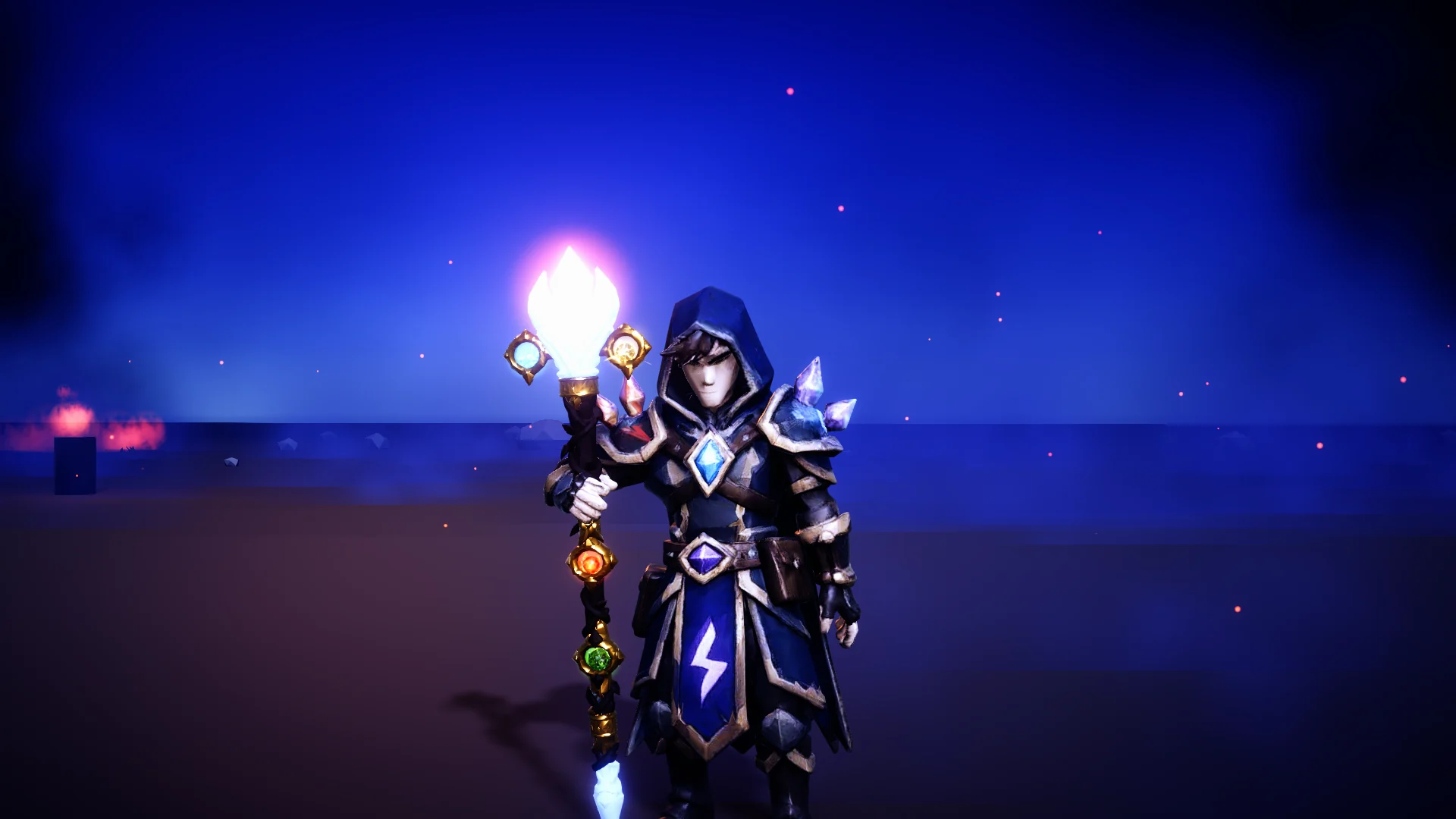
The Elementalist today, captured in-game.
In the next post I'll go through the six elements: what makes each one different, how they each help the builder, and the ultimates that cap each one off.