Six elements, two weapons, four tiers each, twenty upgrade paths per element, talents and relics on top. At some point you can no longer feel your way to balance by playing. You need numbers. In this last hero post I'll show the balance sheet I built, what it told me, and what we changed because of it, with the numbers from before and after.
A balance model instead of gut feeling
The balance sheet is a model of the heroes. It reads the real values out of the game's code and prefabs: damage, cooldowns, mana costs, talent and relic bonuses. Where the game doesn't define something, documented design values fill the gap. On top of that comes a list of explicit assumptions: how many enemies an area spell hits, how long the route is, and how much of the time a melee hero is actually hitting something. The model then plays out fifty endless waves with levels, talents, gold and relics. One full run takes about a tenth of a second.
Inputs and results are saved, so every change can be compared with a baseline before anyone touches the game. You can try a difficulty or a build on paper first.
The main number is coverage: the damage a hero can deal in the time a wave is on the field, divided by the total health of that wave. Below 100% there's a gap the hero can't close on his own under these assumptions. Control effects buy extra time and so raise coverage. It is not a win rate; it's a way to see where the weak spots are.
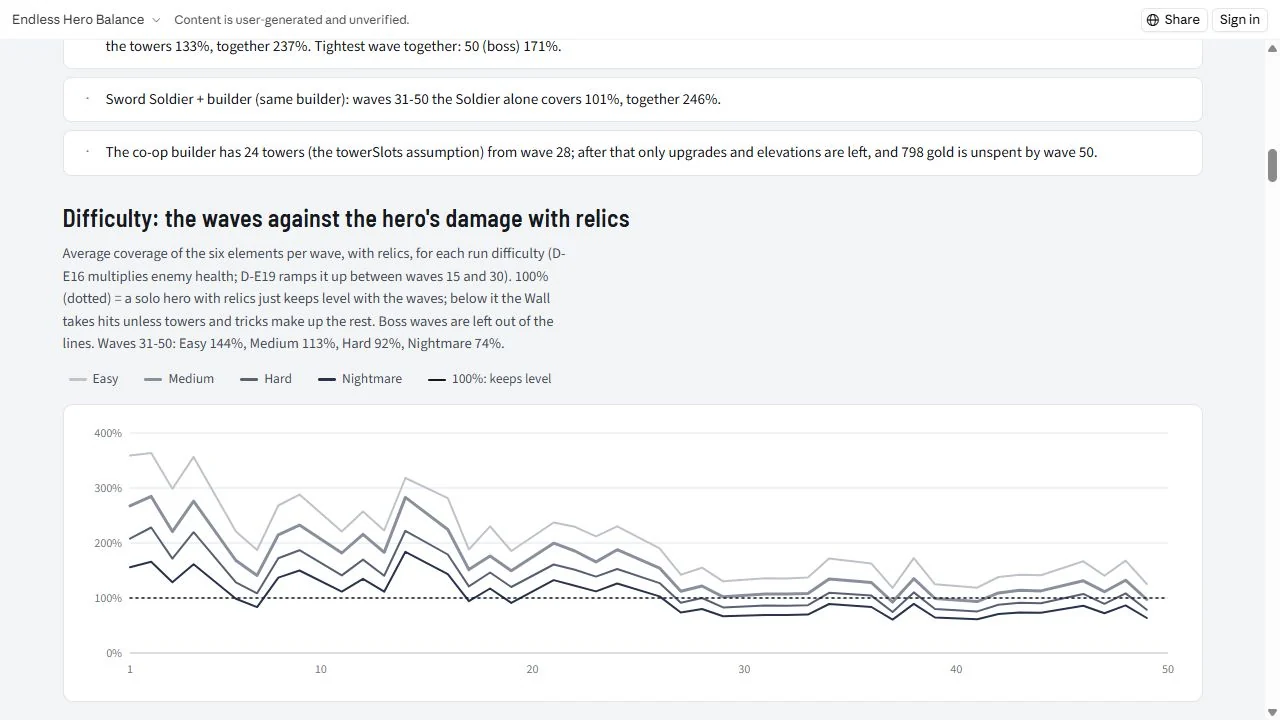
The interactive balance report, snapshot of 28 September.
What it told us
1. Tier I was stronger than Tier IV
This was the big one. In four of the six elements the tiers didn't climb. In Fire and Lightning the very first spell even beat the ultimate. Lightning was the worst: Chain Lightning (Tier I) dealt 4.5 times as much damage per second as Stormcaller (Tier IV), and the Phoenix did less than the first Fireball. In Ice and Shadow, Tier I beat both Tier II and Tier III. That turns progression upside down: why work toward an ultimate that does less than your first spell?
On 27 September we set a clear rule: Tier I has the least impact, Tier IV the most, in every element. Base damage now rises with the tier. Support abilities, like the Healing Tree or Divine Aegis, are judged on what they do for the team, not on damage. The chart shows the result: the grey dashed lines zig-zag, the blue lines climb.
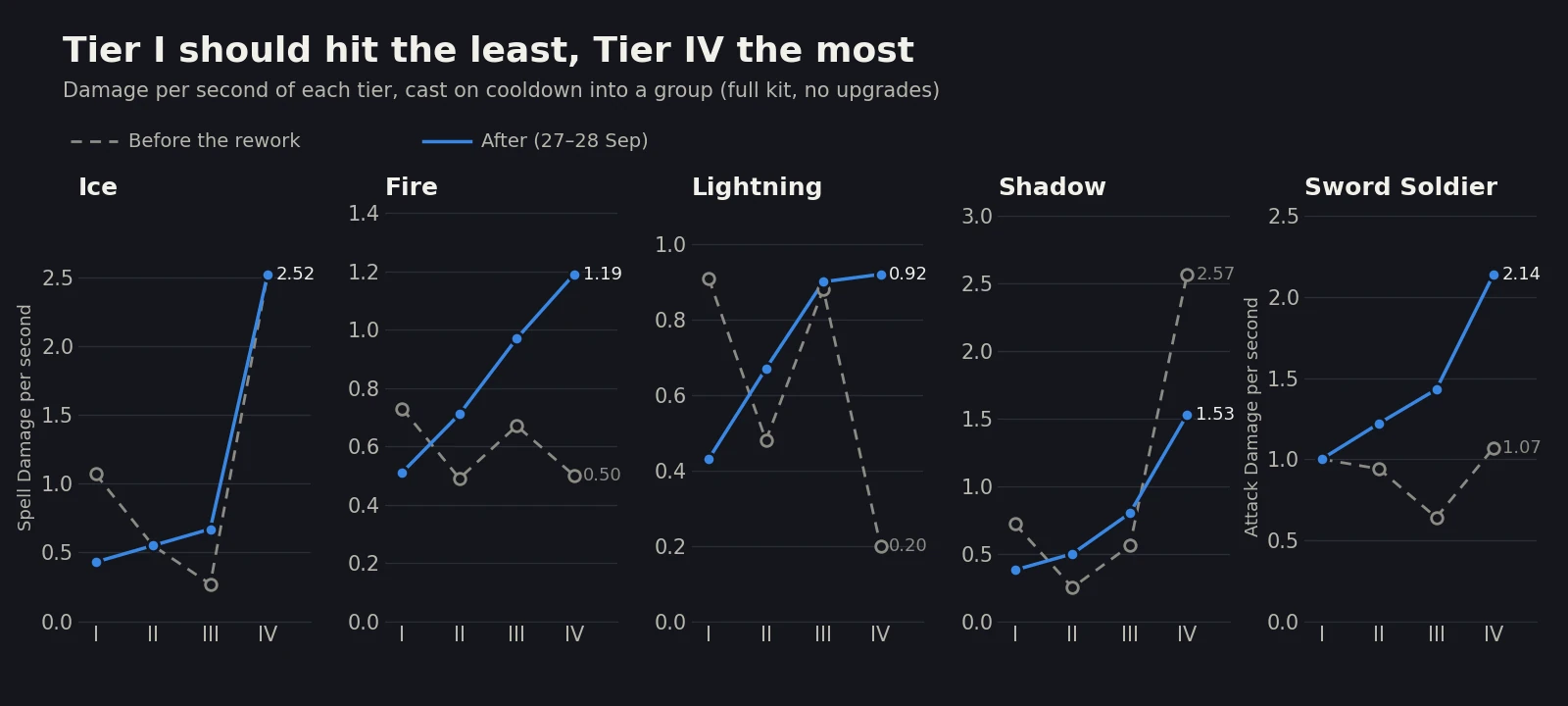
Model values: damage per second of each tier, cast on cooldown into a group. Grey dashed: before. Blue: after the rework.
| Lightning, spell damage per second | Before | After | | --- | ---: | ---: | | Chain Lightning (Tier I) | 0.91 | 0.43 | | Stormcaller (Tier IV) | 0.20 | 0.92 |
That made a Tier-I-only hero weaker early on, so the endless waves now start a bit smaller and grow faster. Together with weaker first bosses, the start actually got easier: without relics, the first boss went from 73–93% coverage to 119–181%. Talent points can make your start stronger still.
2. Upgrades barely mattered
The base damage of every spell was so high that a +10% upgrade hardly showed. On 26 September I halved the base damage of all abilities, so the choices you make during a run carry more weight. The staff's basic attack went through the same process: from 9, down to 1 (too weak), and finally to a roll between 2 and 10, averaging 5.
3. The Sword stopped growing
The model showed the Sword Soldier doing fine early and falling far behind in the late waves. At wave 29 he dealt 32 damage per second, while the six elements dealt 137 to 208. There were three causes. Damage was rounded at every step, so small improvements disappeared. Several relic effects didn't reach his abilities at all. And his damage didn't grow with the sword's tier: his attack damage went from 4 at wave 1 to only 5 at wave 50.
We fixed the rounding, made each sword tier add damage, added Sword Mastery as a reward and Momentum stacks for landing hits, and hooked up the relics. His attack damage now grows from 4 to almost 12 by wave 50 (almost 15 with relics), and at wave 29 he sits right among the elements.
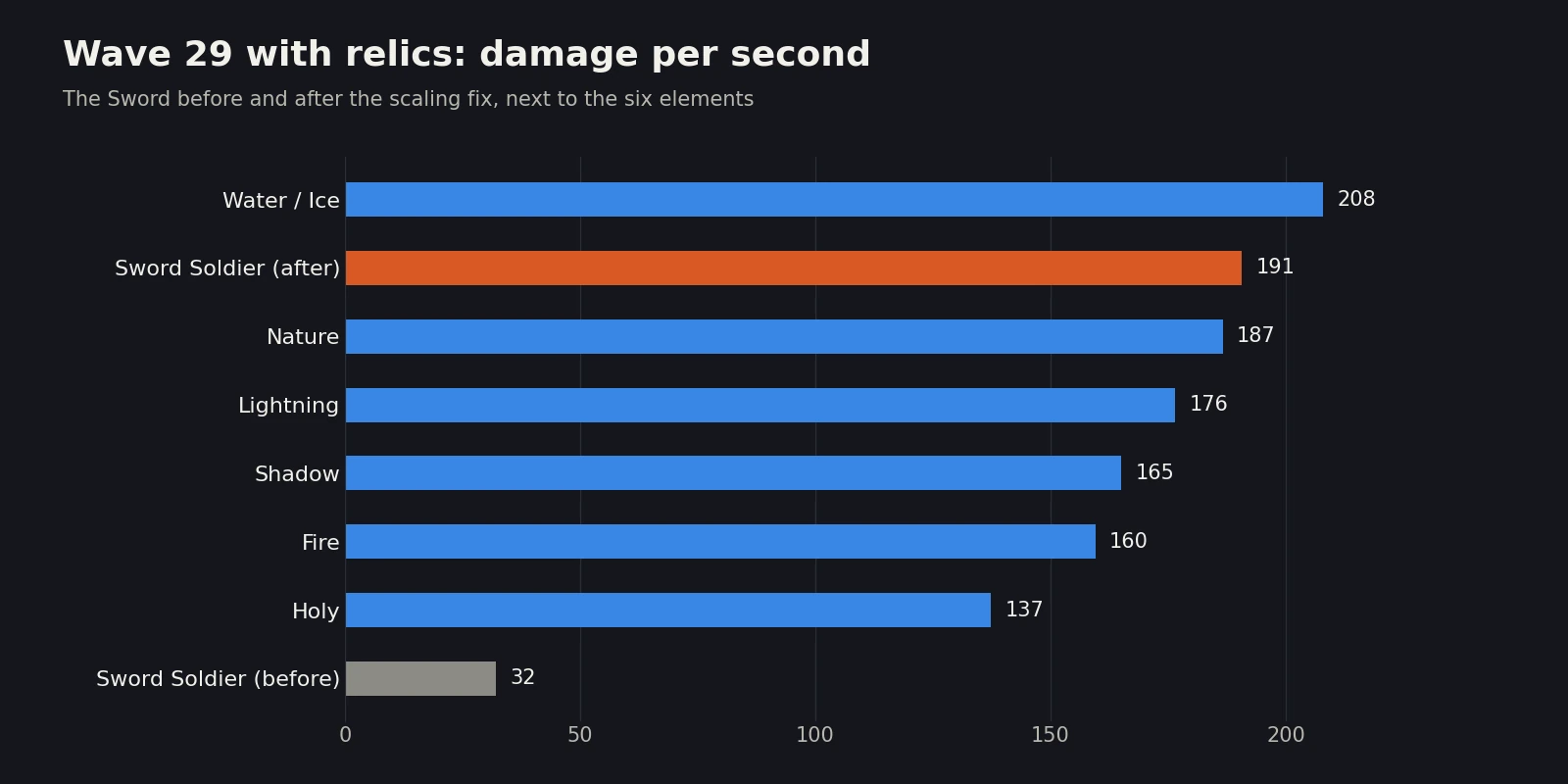
Model, wave 29, Medium, with relics.
| Sword Soldier | Before | After | | --- | ---: | ---: | | Damage per second at wave 29 | 32 | 191 | | Average coverage, waves 31–50 | 20% | 105% | | Coverage in co-op with a builder | 151% | 246% |
Model experiment of 28 September: Medium difficulty, one hero, 10 weapon talent points, a 52-metre route and 75% of the time spent hitting.
We also tried the fixes one at a time before choosing. The new relics and their hooks alone got him to 26%, tier damage alone to 47%, and only all of them together got him past 100%.
4. Smaller fixes
- Chain Explosion (a Fireball upgrade) dealt full damage in a big radius and outshone everything else. With 14 talent points, Fire covered 371% of the late waves while the others sat at 105–196%. It now deals half damage in a smaller radius, and Fire comes out at 198%: still on top, which is deliberate, because Fire has almost no control.
- Entangle let go too quickly. The stun on entering went from 1 to 3 seconds, and the field now also damages bosses.
- Ice costs were 8 mana for every spell, ultimate included. Now they rise with the tier.
- Gaia came back a little sooner, and the Carnivorous Plant bites a little harder.
Where the heroes stand now
This is what the current model says about the late game: the ordinary waves 31 to 50 on Medium, one hero with relics, no towers.
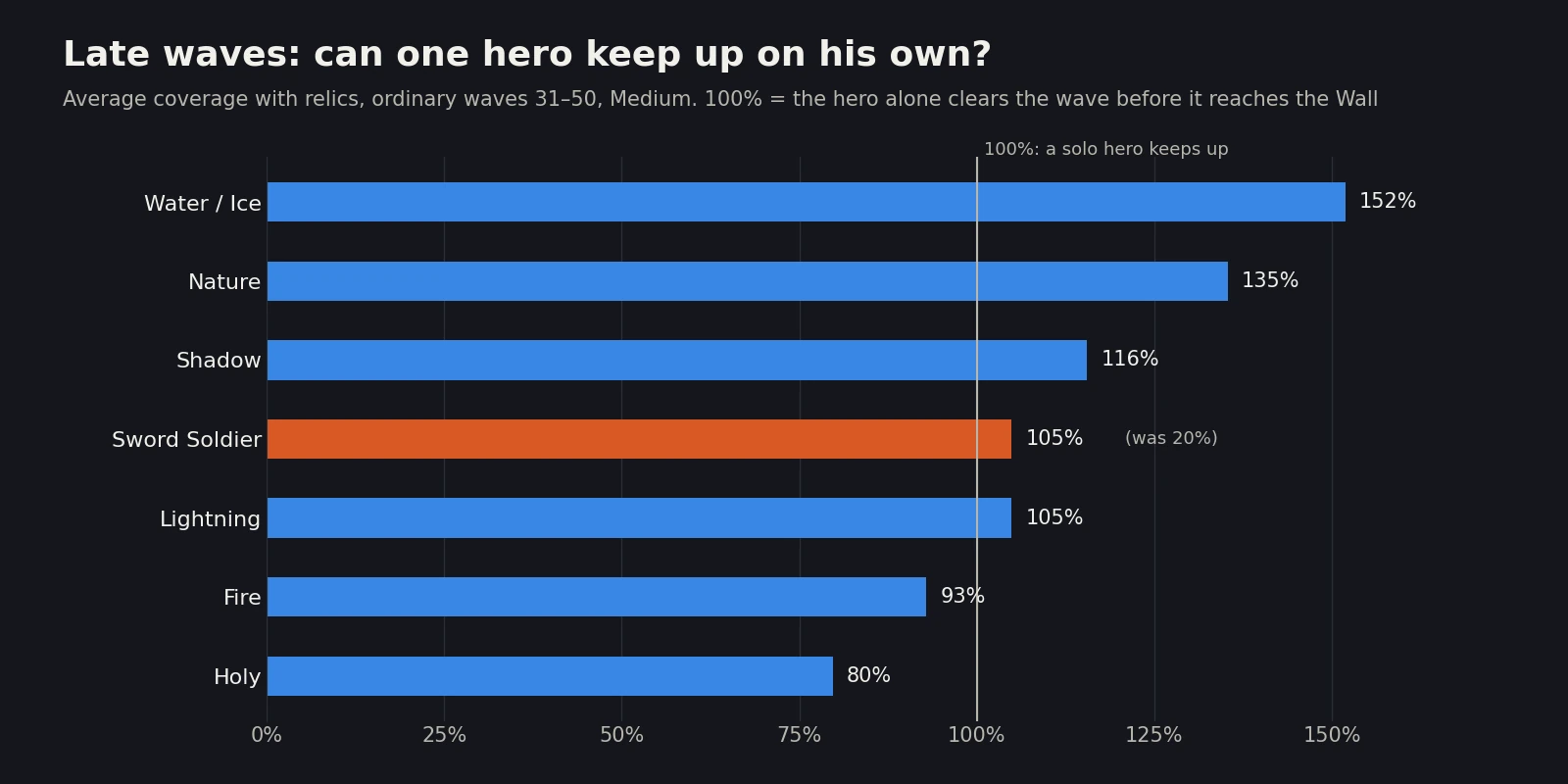
Model of 28 September. Holy's shields and healing are not in these numbers, only its damage.
The six elements average 113%. That's the target: a good solo hero just keeps up on Medium. The spread is real, though. Water/Ice and Nature are comfortable, while Fire and Holy fall a little short on their own. For Holy that's partly a modelling gap, since its protection doesn't show up as damage.
The curve over the whole run tells the same story. Early waves are easy, the middle gets tighter, and from wave 30 everything converges around the 100% line.
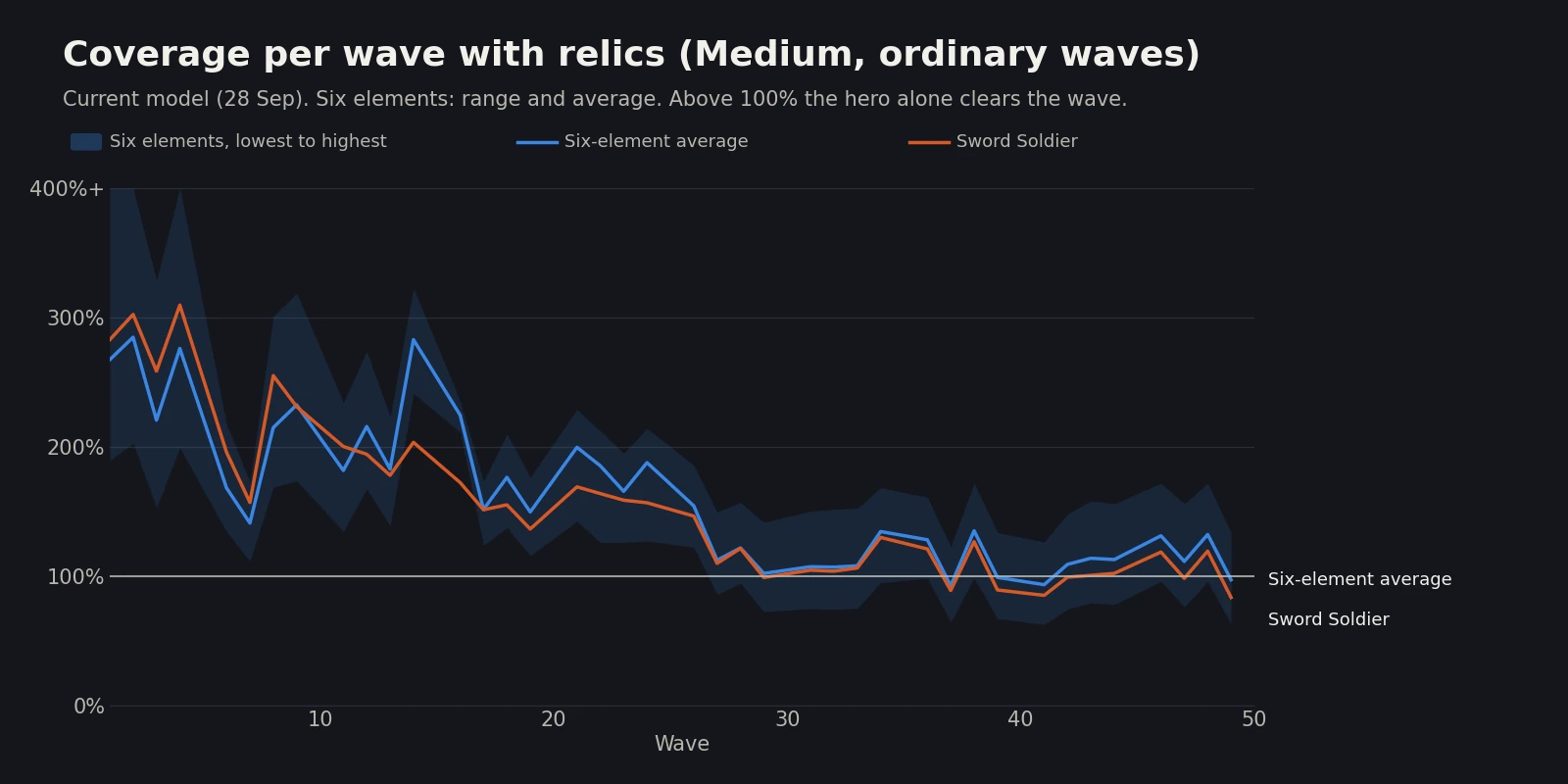
Current model. The band is the range between the weakest and strongest element on each wave.
A few more numbers from the same run:
- Relics matter a lot. At wave 29 they multiply a hero's damage by 1.8 to 2.9 times. Without relics, the same late waves drop to about 41% coverage.
- The waves grow faster than the hero. From wave 6 to wave 49 the damage a wave demands grows about 34 times. The hero's own damage, without relics, grows about 7.5 times. Relics, talents and teammates close that gap.
- Difficulty settings now spread out cleanly. Average late-wave coverage with relics:
| Difficulty | 27 Sep | 28 Sep | | --- | ---: | ---: | | Easy | 132% | 144% | | Medium | 105% | 113% | | Hard | 85% | 92% | | Nightmare | 69% | 74% |
The step from 27 to 28 September comes from talent levels adding damage (+10% per level).
Co-op is the point
All of the above is one hero alone, without towers. That's not how the game is meant to be played. The model also simulates the builder: the gold they earn, which towers they buy, and how much damage those towers deal. Put one hero and one builder together and the picture changes completely.
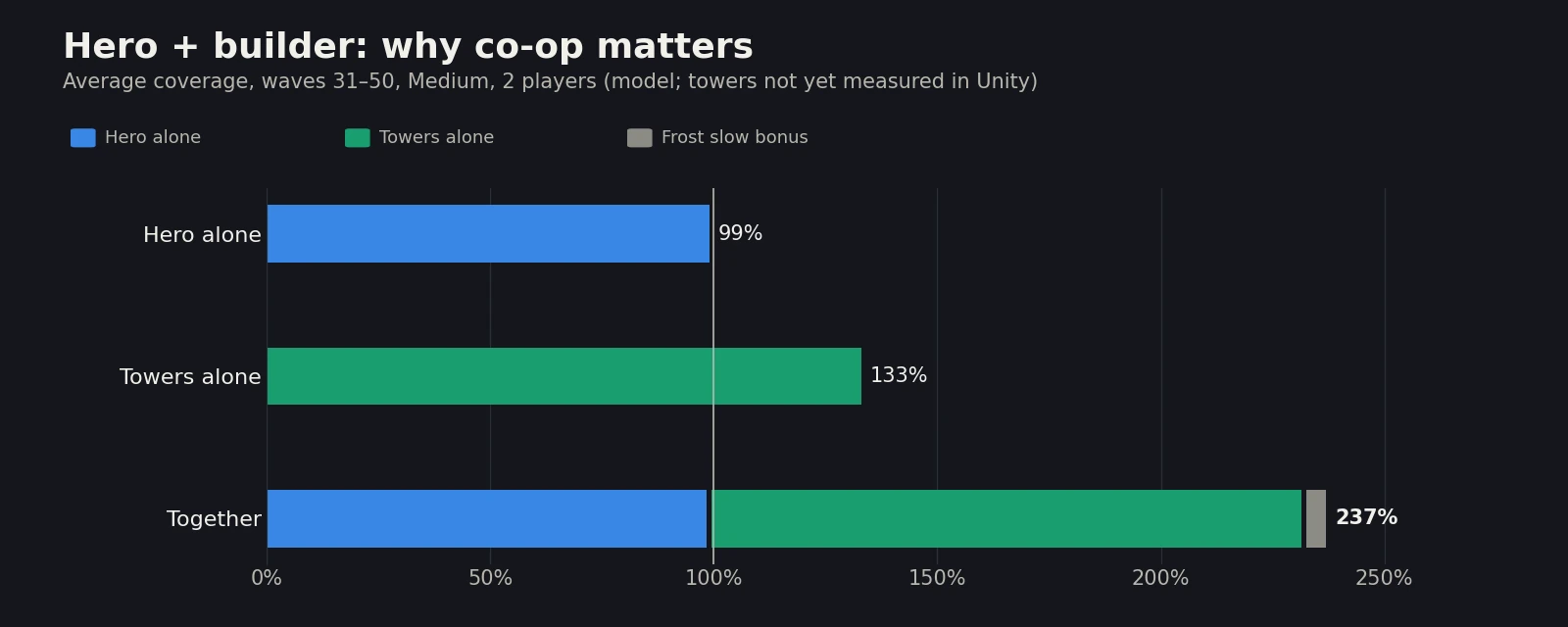
Model, waves 31–50, Medium, 2 players. The tower part of the model hasn't been measured in Unity yet.
Together they cover 237% of the late waves on Medium, and still 142% on Nightmare. That's exactly what we want Nightmare to feel like: hard alone, doable as a team.
What the model can't tell you
A model is a snapshot, and I try to be honest about its limits:
- It doesn't know whether something feels good. The Sword's timing windows, the Maul's weight and the Phoenix's dive all need hands on a mouse.
- In Unity we checked that the first twenty waves match the model in enemy types and total health: 20 out of 20. Total hero damage over a played wave hasn't been calibrated against it yet, and neither has tower damage.
- Survival, random reward offers, healing and shields still have to prove themselves in real games.
- The Maul isn't in the model yet.
- The stored snapshot still gives the Elementalist an old free starter upgrade, so its numbers need refreshing before the next comparison.
Problems that weren't about numbers
Not everything that came out of testing was a balance number:
- Skeletons getting stuck. They walk without full pathfinding, so they got stuck on small ledges. They now step over low obstacles, give up on a target they can't reach, and if they're really stuck, crumble and rise again next to the mage.
- Lightning was expensive. The bolts were reshaped and resent to the other players dozens of times per second. Caching, a lower update rate and caps on simultaneous impacts fixed that.
- Invisible fire. Burning enemies didn't look like they were burning for your co-op partners. The host now sends the burn level, and one shared effect shows it.
What's next
- Fine-tuning the Sword and the Maul in real fights, and adding the Maul to the model.
- Rethinking the Elementalist so that aiming, positioning and timing matter more across the whole kit, the way they already do for the Phoenix's dive and the plant's ambush.
- Sword & Shield for the Soldier, and after that the Hunter.
- Refreshing the balance model and measuring real play and real towers against it.
That's the hero side of The Last Bastion so far. Thanks for reading along, and see you on the battlefield.