Every tower defence game lives or dies by its enemies. A tower is only interesting when there is something worth aiming it at, and a hero only feels strong when the thing in front of them has a shape, a role and a reason to be there. That is why we are giving The Last Bastion not one pile of monsters, but three enemy factions, each with its own look, its own story and its own way of putting pressure on your walls.
This is the first of three posts. We start with the faction you meet first: the Iron Horde.
An army, not a crowd
The Iron Horde is an orc and kobold war band that marches on the Bastion like a real army. It has a front line, heavy hitters, support in the second row, fast runners on the flanks and something in the air. Our rule for the roster was simple: you should be able to tell at a glance what is coming, from the hero's camera down on the battlefield and from the Builder's view high above it.
The roster has nine regular units and one boss:
- Orc Warrior (front line): The baseline. Every other unit is measured against it.
- Orc Shieldbearer (heavy): A wall of wood and iron that is slow but hard to bring down.
- Orc Breaker (heavy): A wide, hammer-swinging siege threat for your walls.
- Orc Drummer (support): The drum in the second row sets the pace of the war band.
- Kobold Runner (skirmisher): Small, fast and armed with a spear. It finds the gaps.
- Kobold Ash Thrower (ranged): Lobs clay pots of ash from behind the front line.
- Kobold Saboteur (specialist): A pick in one hand, a bomb in the other.
- Kobold Sparkbinder (caster): A crystal staff that crackles with stolen lightning.
- Kobold Skyraider (flying): A kobold on a war eagle that ignores your carefully built route.
- Grukhar Irontooth, the Orc Warlord (boss): The commander, and the reason the war band holds together.
Big and heavy versus small and fast
The contrast between orcs and kobolds is deliberate. Orcs are large, armoured and slow: the Shieldbearer and the Breaker move at around 2.4 m/s and can take more than one and a half times the punishment of a Warrior. Kobolds are small, quick and fragile: the Runner reaches about 4.2 m/s with little more than half the Warrior's health. When a wave mixes both, you have to choose: do you hold the line against the heavy units, or do you chase the little ones before they slip past?
The Skyraider adds a third question. It flies, so it does not care about the maze of walls and palisades you built. You need defences that can reach the sky.
From prototype blocks to a real war band
The Horde started out as simple low-poly prototypes built in Blender: one skeleton per unit, with a walk or run, an attack and a death. That was enough to test pacing, walls and routes. It was not enough to make you feel an army coming.
So every unit that marches in the first act now has a new, much more detailed model: heavier armour, clearer weapons, skulls and trophies, and a heavier, more menacing walk. Each model sits on the unit's own skeleton, with its own attack and death animation. The attack is timed to the actual hit, so when you see the axe come down, that is when the wall takes damage.
Doing this for a horde has a cost, so we measured it. The new models have more detail, but each one uses a single mesh and a single material instead of up to thirty-five. In our battle benchmark, a fight with 200 enemies actually ran faster afterwards. More detail and a larger horde can go together.
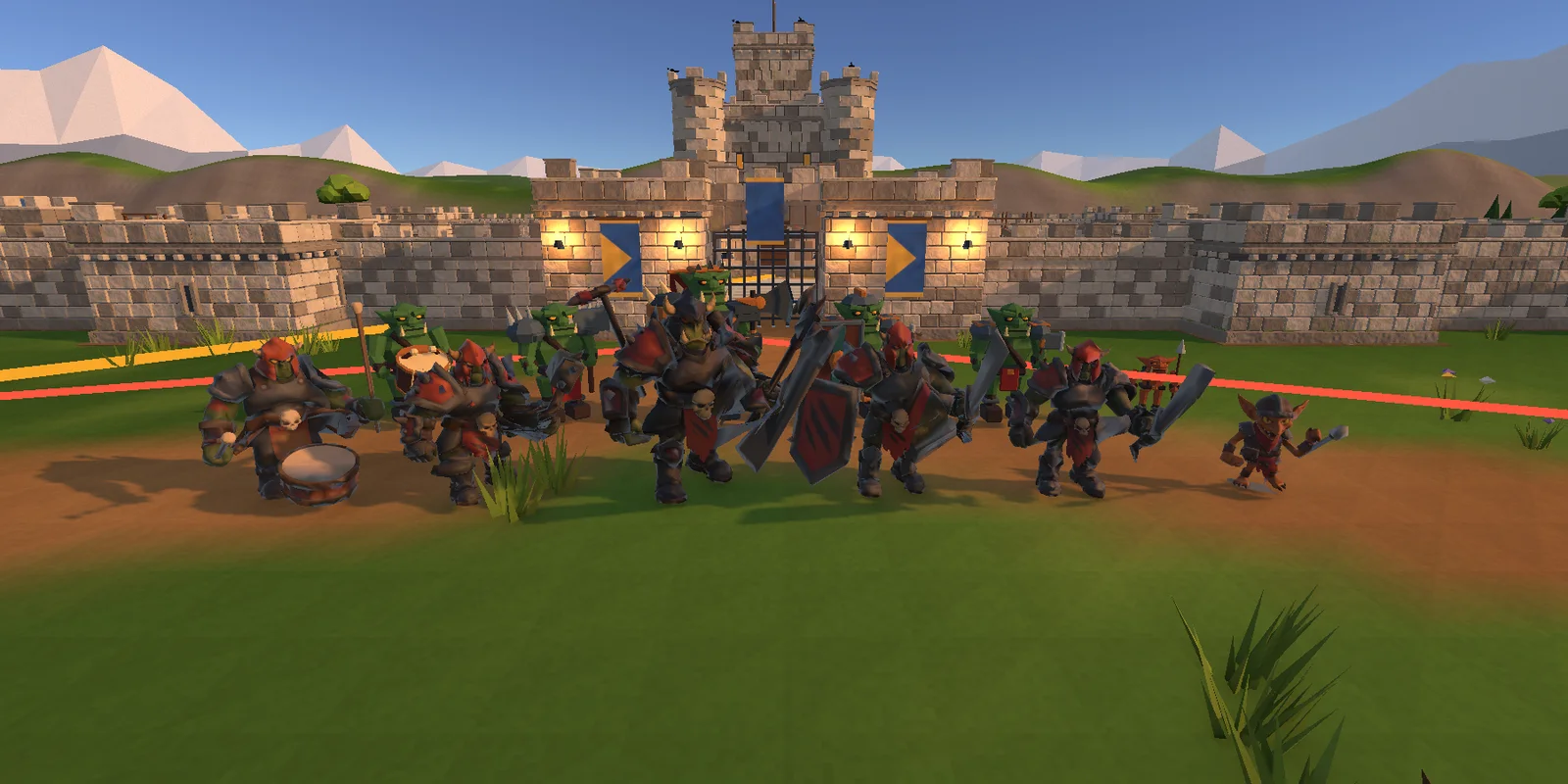
In-game capture from our development build: the Iron Horde lined up in front of the Bastion's gate.
What is next
The roles you see above are communicated through silhouette, speed and health. The Drummer's rhythm, the Saboteur's explosives and the Sparkbinder's lightning do not yet have their own special mechanics; those need careful design because they touch the combat rules of heroes and towers too. Health and speed are trial values we keep tuning in playtests.
In the next post we leave the mud and iron behind and look to the sky, where the AshWing is waiting.
Cover: illustrative concept art. The in-game models may differ.