In the first faction post we met the Iron Horde: mud, iron and a war band that marches in step. The second enemy faction of The Last Bastion could hardly be more different. It gathers around fire, it worships dragons, and a good part of it does not walk at all.
Meet the AshWing.
A cult of flame and dragonkind
The AshWing gather around flame and dragonkind. Hooded cultists and brood watchers walk alongside scaled fighters and hounds of molten stone. Above them, young drakes and sky talons take to the air, and over the whole brood towers the Ancient Ash Dragon.
Where the Iron Horde is earthy and physical, the AshWing is fiery and airborne. We gave the faction a strict palette so you can recognise it from any distance: charcoal black, deep crimson and ember orange. Horns and spines break up the silhouettes, glowing eyes and lanterns point you to the important units, and wings make the flyers readable even from the Builder's view high above the battlefield.
The roster
Like the Iron Horde, the AshWing has nine regular units and one boss. Three of them fly.
- Ash Stalker (skirmisher): A lean, horned hunter that arrives before the rest.
- Ember Cultist (support): A hooded figure in red robes with a burning staff.
- Ashscale Guard (heavy): Black armour, red horns and a tall dark shield.
- Cinder Spewer (ranged): Hurls cinders at your defences from behind the line.
- Flamebound Raider (skirmisher): Two glowing blades and a fast, aggressive run.
- Brood Watcher (support): Carries an orange lantern and keeps an eye on the young.
- Lava Hound (beast): Low, quick and fragile, with cracks of molten orange.
- Drake Whelp (flying): A young red dragon: the first dragon most players will meet.
- Sky Talon (flying): A larger flyer with a wingspan of more than four and a half metres.
- Ancient Ash Dragon (boss): Black scales, crimson wings and a wingspan of over eight metres.
Dragons that come for your walls
Flying enemies are a different kind of problem in a game about building routes. Your walls and palisades decide where ground units walk; a dragon simply flies over them, about three metres above the ground, straight for your defences. That means you need towers and heroes that can hit the sky, and you have to think about where they stand.
The Drake Whelp is the dragon that already appears in the waves you play today. It replaced our old prototype red dragon and took over its place in the game, so every wave that used to send a dragon now sends a whelp.
The Ancient Ash Dragon is a different beast. Its wings are so wide that we had to think carefully about how it approaches the Bastion: the visible dragon and its hit area sit a little behind its flight path, so it looms over your wall towers instead of clipping through them.
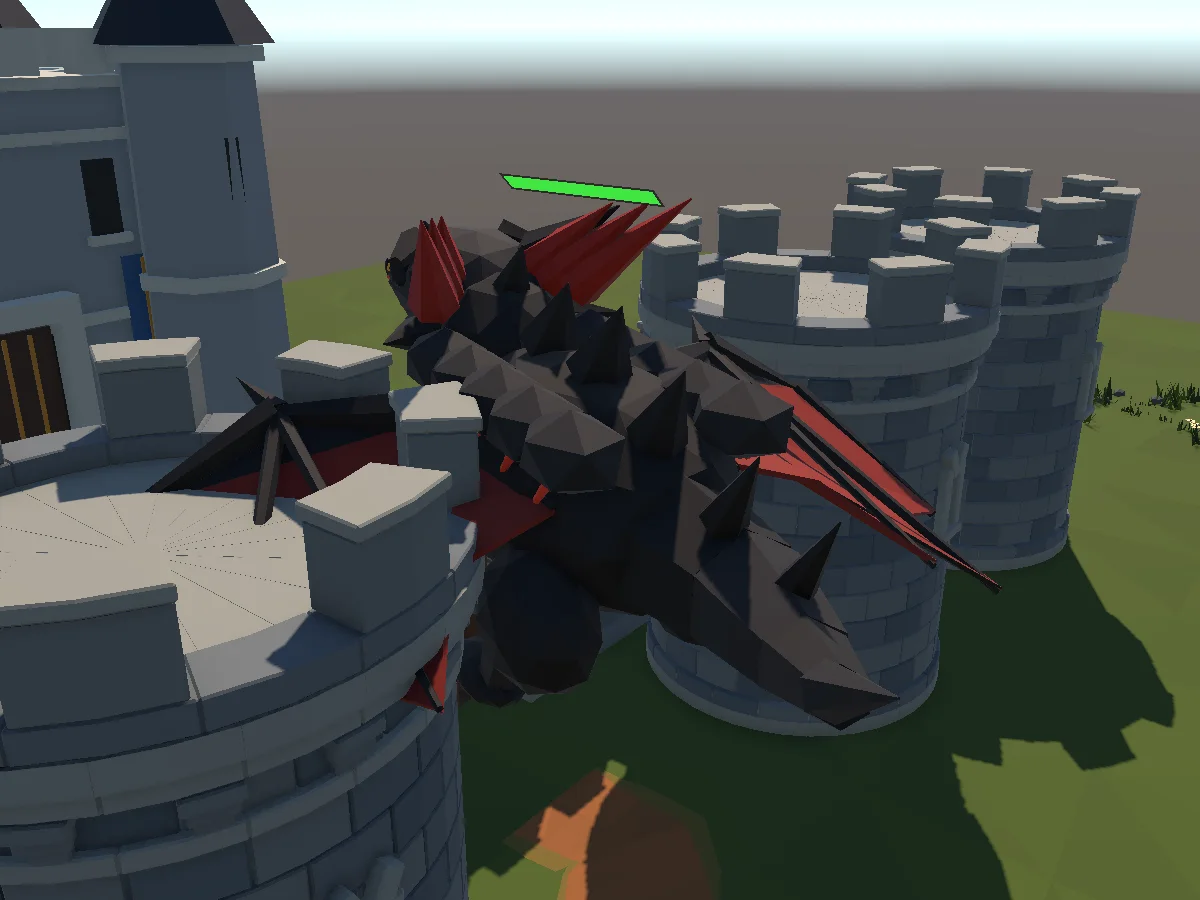
In-game capture from our development build: the Ancient Ash Dragon attacking a wall tower.
Built to move
Every AshWing unit was built in Blender first, with its own skeleton and four animations: moving, idling, attacking and dying. That makes forty animations for the faction. The flyers keep beating their wings while they attack, and when a dragon dies it tilts, folds its wings and drops, instead of just disappearing. The ground units run, walk or prowl according to their role: the Lava Hound and the Ash Stalker run, the Ashscale Guard walks with weight.
As with the Iron Horde, the attack animation builds up to the moment of impact, and that moment is when your wall actually takes damage. What you see and what happens are the same thing.
What is next
Right now the Drake Whelp is the AshWing unit you will meet in the regular waves. The rest of the faction is fully playable in custom scenarios, where we use them to test pacing and balance. The Ancient Ash Dragon has trial values but no special boss attacks yet: fire breath, summoning whelps or other boss phases are things we want to design properly rather than bolt on. As with every faction, health and speed are trial values.
In the third and final post of this series we introduce our newest faction: the Gravebound.
Cover: illustrative concept art. The in-game models may differ.